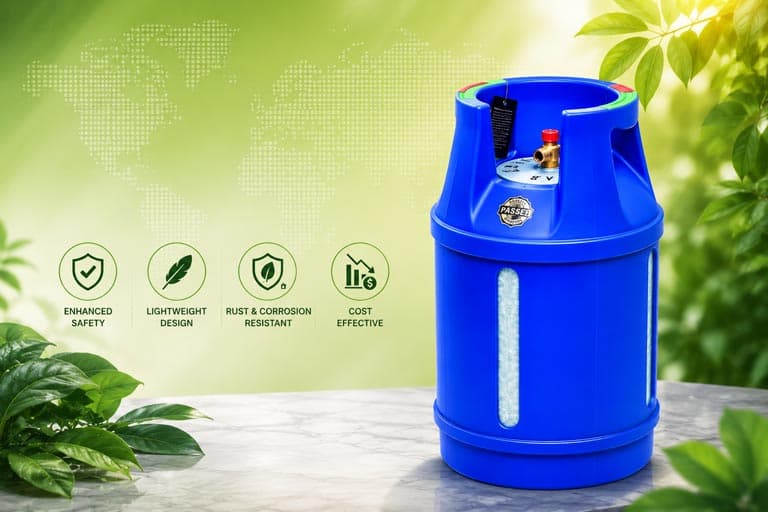
PARCO and WAA Technologies are two prominent names in Pakistan's LPG cylinder market. This honest comparison covers cylinder type, safety certification, price, weight, gas level visibility, dealer network, and after-sales support — so you can decide which is right for your home.
Key Takeaways
- ✓PARCO (Pak-Arab Refinery) is an LPG producer and distributor — it sells steel cylinders through its retail network
- ✓WAA Technologies is a composite cylinder manufacturer — its cylinders are non-blast, translucent, and 20+ year rated
- ✓These are fundamentally different product categories: PARCO sells a conventional steel pressure vessel; WAA sells a modern composite one
- ✓For households prioritising safety, WAA composite cylinders are the superior choice — for lowest upfront cost, steel is cheaper
- ✓Both are sold through OGRA-licensed distribution channels
Pakistani consumers searching for the best LPG cylinder often compare brand names they have encountered — PARCO, WAA Technologies, and others. Understanding this comparison requires understanding what each organisation actually does in Pakistan's LPG sector, because PARCO and WAA Technologies are not directly competing products in the same category. They are different types of businesses selling different types of cylinders. For a direct technical comparison between cylinder materials, see the guide on steel vs composite LPG cylinders in Pakistan. This guide explains each company's role, products, and the genuine comparison points that matter for Pakistani households and businesses.
What Is PARCO?
PARCO — Pak-Arab Refinery Company Limited — is a joint venture between the Government of Pakistan (60%) and the Abu Dhabi National Energy Company (40%). It operates a major petroleum refinery in Mahmood Kot, Punjab, producing a range of petroleum products including LPG as a refinery by-product. PARCO sells LPG through its retail network under the PARCO brand, distributed in conventional steel cylinders to domestic and commercial consumers primarily in Punjab and other areas served by its pipeline network.
PARCO is not primarily an LPG cylinder manufacturer — it is an LPG producer and marketer. The steel cylinders through which PARCO distributes its LPG are conventional steel pressure vessels manufactured to PS 4922 or equivalent specifications by contracted cylinder manufacturers. When you buy PARCO-branded LPG, you are buying the gas (LPG) itself — the cylinder is the standard delivery vessel.
What Is WAA Technologies?
WAA Technologies Pvt Ltd is a Pakistani manufacturer of composite LPG cylinders, headquartered in Lahore (showroom: Bahria Town) with its production facility in Gujranwala, Punjab. WAA Technologies designs and manufactures composite cylinders — HDPE-lined, glass-fibre-wound pressure vessels certified to ISO 11119-3 and EN 14427-2022 international standards. WAA Technologies does not produce or sell LPG gas itself. It manufactures the cylinder — the container — which is then filled with LPG purchased from an OGRA-licensed LPG distributor (which could be PARCO, PSO, or any other licensed distributor).
This is the key distinction: PARCO sells LPG gas (in steel cylinders). WAA Technologies sells composite cylinders (which you then fill with LPG from any licensed source). They are not in direct competition — they are in different parts of the LPG value chain. Many Pakistani households use a WAA Technologies composite cylinder filled with LPG sourced from PARCO-affiliated dealers.
Comparing the Cylinders: PARCO Steel vs WAA Composite
The meaningful comparison is between the type of cylinder each company's products represent: conventional steel vs composite. Here is how they compare on the factors that matter most for Pakistani households:
Safety: PARCO steel cylinders are manufactured to PS 4922 — the Pakistani standard for steel cylinders. They meet the minimum legal safety standard for steel LPG cylinders in Pakistan. WAA Technologies composite cylinders are certified to ISO 11119-3 and EN 14427-2022 — international standards that include fire engulfment testing confirming non-blast behaviour. The composite cylinder physically cannot rupture and project shrapnel. The steel cylinder can, under fire or over-pressure conditions. This is a fundamental, non-trivial safety difference.
Gas level visibility: PARCO steel cylinders are opaque — you cannot see the gas level without lifting and estimating weight. WAA Technologies composite cylinders are translucent — the gas level is visible at a glance. For daily household convenience, this is a significant practical advantage of composite.
Weight: A PARCO 12 kg steel cylinder weighs approximately 30–32 kg when filled. A WAA Technologies 12 kg composite cylinder weighs approximately 18–20 kg when filled. The 40% weight reduction makes composite cylinders easier and safer to handle, particularly for women, elderly users, and anyone who moves cylinders regularly.
Corrosion: Steel cylinders — including PARCO-branded ones — corrode in Pakistan's climate. Rust on the cylinder body is an expected reality after 3–5 years of normal outdoor or kitchen-floor storage. WAA composite cylinders cannot corrode — HDPE and glass fibre are chemically inert materials. In high-humidity environments like Karachi, or wherever cylinders are stored outdoors, this is a significant long-term advantage.
Price: PARCO steel cylinders cost Rs. 4,000–5,500 per unit. WAA Technologies composite cylinders cost Rs. 9,000–14,000 per unit. PARCO steel is significantly cheaper at purchase.
Service life: Steel cylinders require hydrotesting every 5 years and typically last 8–12 years in Pakistani conditions. WAA composite cylinders are rated for 20+ years with no periodic hydrotesting requirement.
Which Is Better for Pakistani Households?
If your primary consideration is lowest upfront cost, a standard steel cylinder — whether PARCO-branded or otherwise — is cheaper to purchase today. If your primary considerations are safety, long-term value, daily convenience, and weight, WAA Technologies composite cylinders are the superior choice on every dimension except purchase price.
For families with young children (who are disproportionately affected by blast injuries), elderly household members (who find 30+ kg cylinders difficult to move), or anyone living in Pakistan's high-humidity coastal or monsoon environments, the advantages of composite shift the calculation further toward WAA even on a household budget.
Frequently Asked Questions
Can I use PARCO LPG in a WAA Technologies composite cylinder?
Yes. A WAA Technologies composite cylinder can be filled at any OGRA-licensed LPG filling station — including those supplied by PARCO-affiliated distributors. The cylinder and the gas are separate purchases. Your composite cylinder is simply a container; the LPG that goes into it can come from any licensed distributor in your area.
Is PARCO LPG safe?
Yes. PARCO LPG is a licensed, OGRA-regulated product that meets the specification requirements for LPG sold in Pakistan. The safety question relevant to Pakistan's household accident statistics is not about the quality of the gas — it is about the type of cylinder the gas is stored in. The same gas in a corroded 15-year-old steel cylinder is far more dangerous than in a new certified composite cylinder.
Does WAA Technologies have dealers in all Pakistani cities?
WAA Technologies has an authorised dealer network across Punjab (Lahore, Faisalabad, Gujranwala, Rawalpindi, Multan), Sindh (Karachi, Hyderabad), and KPK (Peshawar, Abbottabad). The network continues to expand. Find your nearest authorised dealer at waatechnologies.com/authorized-dealers or call (+92) 4237815533.
Are PARCO cylinders certified to the same standard as WAA?
PARCO steel cylinders are manufactured to PS 4922 — Pakistan's national standard for steel LPG cylinders. WAA Technologies composite cylinders are certified to ISO 11119-3 and EN 14427-2022 — international standards that include significantly more comprehensive safety testing, including fire engulfment testing that confirms non-blast behaviour. ISO 11119-3 is a more demanding standard than PS 4922 in terms of fire safety performance requirements.