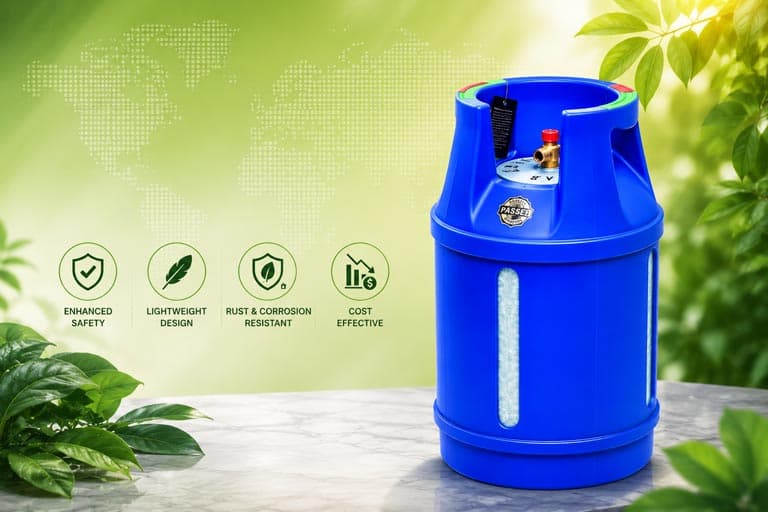
Steel or composite? Pakistani households buying a new LPG cylinder face this choice. This side-by-side comparison covers safety, cost, weight, lifespan, gas level visibility, corrosion, and total value over 10 years — with a clear verdict.
Quick Verdict — Steel vs Composite
Composite Wins:
- ✓ Safety (non-blast)
- ✓ Weight (50% lighter)
- ✓ Gas level visibility
- ✓ Corrosion resistance
- ✓ Service life (20+ yrs)
- ✓ Total cost over 10 yrs
Steel Wins:
- → Lower purchase price
- → More widely available
Key Takeaways
- ✓Composite cylinders are 100% non-blast — they physically cannot explode and project shrapnel. Steel cylinders can and do.
- ✓Composite cylinders weigh 50% less filled — a 10 kg composite cylinder weighs ~18 kg filled vs ~28 kg for steel
- ✓Composite cylinders show the gas level through the translucent body — steel cylinders require lifting and guessing
- ✓Composite cylinders last 20+ years with zero maintenance — steel requires hydrotest every 5 years and replacement every 8–12 years
- ✓Over 10 years, composite total cost of ownership is lower than steel despite the higher upfront price
Walk into any Pakistani hardware market or LPG dealer in Lahore, Karachi, or Islamabad and you will find both options available: the familiar heavy steel cylinder — the "gola" that Pakistani households have used for decades — and the newer composite or fibre cylinder, lighter, translucent, and noticeably more expensive upfront. For most Pakistani families, the buying decision comes down to price, and on purchase price alone, steel wins. But purchase price is not the right metric for comparing a safety product that will sit in your kitchen, be handled by your family members, and ultimately determine what happens if something goes wrong. This comparison covers every dimension that matters.
1. Safety: The Fundamental Difference
This is not a close comparison. Steel cylinders can and do explode. Composite cylinders physically cannot. This difference stems from the materials and construction method.
A steel cylinder is a welded pressure vessel. The weld seams are stress concentration points. Corrosion attacks the steel from outside (rust) and inside (moisture and chemical residue). Over years of use, a steel cylinder develops micro-cracks at welds and in corroded sections. Under sufficient pressure — from over-pressure in a fire, or from metal fatigue after many fill cycles — these cracks propagate and the cylinder ruptures. Because steel stores significant elastic strain energy at working pressure, rupture is not a slow leak: it is a violent fragmentation event projecting lethal metal shards at high velocity in all directions. Pakistan's gas cylinder blast fatality record is essentially entirely attributable to steel cylinder fragmentation.
A composite cylinder has no welds. The seamless HDPE inner liner is wrapped with glass fibre filament wound under calculated tension. Under over-pressure or fire conditions, the composite structure deforms and allows gas to escape through the valve or a controlled wall-leak. The fibres do not fragment. There is no lethal shrapnel. WAA Technologies composite cylinders are tested under ISO 11119-3 fire engulfment protocols — sustained flame applied directly to the cylinder for a specified duration — and in all cases the cylinder develops a gas leak rather than a rupture. This is what "non-blast" means in engineering terms, and it is a certified, tested, and repeatable property.
Verdict: Composite wins decisively. There is no comparison on safety.
2. Weight: Handling in Everyday Pakistani Life
A filled 12 kg steel LPG cylinder weighs approximately 30–32 kg. A filled 12 kg WAA composite cylinder weighs approximately 18–20 kg. The weight difference — approximately 12 kg, or about 40% — is significant in the practical context of Pakistani household life, where cylinders are carried up stairs, moved between rooms, handled by women and older family members, and changed by whoever is home when the gas runs out.
In commercial settings — restaurant kitchens, hotel cooking facilities, wedding catering — the weight difference is even more operationally significant. Kitchen staff may change cylinders multiple times per day. The composite cylinder's lighter weight reduces physical strain and lifting injuries, lowers the probability of dropping accidents that damage valves, and makes it practical for a single person to manage cylinder changes without assistance.
Verdict: Composite wins by a wide margin — 40–50% weight reduction.
3. Gas Level Visibility: The Practical Daily Advantage
With a steel cylinder, you cannot see how much gas remains. The standard Pakistani methods of checking — lifting and judging weight, pouring hot water on the side and feeling for the cool line, or tapping and listening for a tone change — are all imprecise and awkward. In a busy household or commercial kitchen, the result is either running out of gas unexpectedly mid-cooking, or calling the dealer for a new cylinder when the old one was actually half-full.
WAA composite cylinders have a translucent HDPE body. The liquid LPG level is directly visible through the cylinder wall — like looking at a water bottle. A three-second glance from across the kitchen tells you exactly how much gas remains. This single feature eliminates an entire category of daily domestic frustration and commercial kitchen service disruption.
Verdict: Composite wins outright — steel offers no visibility at all.
4. Corrosion Resistance
Steel corrodes. In Pakistan's operating environment — monsoon humidity, coastal salt air in Karachi, temperature extremes, outdoor storage — steel cylinders begin showing surface rust within 2–3 years of manufacture. Internal corrosion from moisture and LPG residue develops simultaneously. Corrosion weakens cylinder walls, attacks valve seats reducing seal quality, and shortens the cylinder's effective safe service life.
HDPE and glass fibre — the materials of composite cylinders — are chemically inert. They do not corrode, rust, or degrade from moisture exposure. A composite cylinder stored outdoors in Karachi's coastal humidity for 20 years will have the same structural integrity as on the day it was manufactured. No painting, no anti-rust treatment, no periodic inspection for surface degradation required.
Verdict: Composite wins completely — it literally cannot corrode.
5. Service Life and Maintenance
Steel cylinders must be hydrotested every 5 years under OGRA rules — a process that requires the cylinder to be professionally inspected and pressure-tested at an OGRA-licensed facility. Steel cylinders in commercial use realistically last 8–12 years before corrosion or mechanical damage forces retirement. In household use, many Pakistani households continue using steel cylinders for 15–20 years, well beyond their rated service life, because there is no visible indication that the cylinder is no longer structurally sound.
WAA composite cylinders are rated for 20+ years and 12,000 fill cycles under ISO 11119-3. They require no periodic hydrotesting. Visual inspection of the transparent body for any damage or impact marks is the only routine maintenance required. The absence of corrosion means the cylinder's safe service life is not shortened by environmental exposure.
Verdict: Composite wins — longer life, zero maintenance.
6. Purchase Price vs Total Cost of Ownership
A standard 12 kg steel LPG cylinder purchased from an authorised Pakistani dealer costs approximately Rs. 4,000–6,000 (2025 prices). A WAA Technologies 12 kg composite cylinder costs approximately Rs. 10,000–14,000 (2025 prices). On purchase price alone, steel is significantly cheaper.
However, over a 10-year ownership period:
- A steel cylinder requires 1–2 hydrotests (Rs. 500–800 each) and will likely need replacement once or twice (Rs. 4,000–6,000 per replacement)
- A composite cylinder requires no hydrotest and no replacement — it will still be within its rated service life at year 10
- The composite cylinder's gas level visibility eliminates accidental over-ordering of refills, saving an estimated 2–4 unnecessary refill deliveries per year
Adding these costs, the 10-year total cost of ownership is comparable between steel and composite, with composite pulling ahead when operational efficiency savings are included. The composite advantage strengthens significantly in years 11–20, when the composite cylinder continues at zero additional capital cost while steel requires repeated replacement.
Verdict: Steel wins on day-one purchase price. Composite wins on total cost over any period longer than 5 years.
Full Comparison Table
| Feature | Steel Cylinder | Composite Cylinder |
|---|---|---|
| Blast / explosion risk | ⚠️ Yes (BLEVE possible) | ✅ Zero (non-blast certified) |
| Weight (12 kg filled) | ~30–32 kg | ~18–20 kg |
| Gas level visible? | ❌ No | ✅ Yes (translucent body) |
| Corrosion | ⚠️ Rusts over time | ✅ Cannot corrode |
| Service life | 8–12 years typical | 20+ years rated |
| Hydrotest required? | ✅ Every 5 years | ❌ Not required |
| Purchase price (12 kg) | Rs. 4,000–6,000 | Rs. 10,000–14,000 |
| 10-yr total ownership cost | Rs. 12,000–20,000+ | Rs. 10,000–14,000 |
| ISO certification | PS 4922 | ISO 11119-3 / EN 14427 |
| UV resistant | ⚠️ Paint degrades | ✅ UV-stabilised HDPE |
Frequently Asked Questions
Is a composite LPG cylinder really safer than steel for Pakistani homes?
Yes. Certified composite LPG cylinders are physically incapable of the blast fragmentation that makes steel cylinder explosions so deadly. ISO 11119-3 certification requires passing a fire engulfment test where the cylinder develops a controlled gas leak rather than rupturing. Every certified composite cylinder has passed this test. Steel cylinders are not required to pass an equivalent fire engulfment test for domestic certification in Pakistan.
Which composite LPG cylinder brand is best in Pakistan?
WAA Technologies Pvt Ltd, manufactured in Gujranwala and certified to both ISO 11119-3 and EN 14427-2022, is Pakistan's leading domestic composite cylinder manufacturer. WAA cylinders are available through an authorised dealer network across Punjab, Sindh, and KPK. When choosing any composite cylinder, confirm it carries an individual serial number, a visible ISO 11119-3 or EN 14427 certification marking, and is sold through an OGRA-licensed dealer.
Can I switch from steel to composite without changing my regulator?
In most cases, yes — WAA Technologies composite cylinders use standard LPG valve configurations compatible with regulators already in use in most Pakistani households. However, confirm compatibility with your WAA authorised dealer when purchasing, as regulator requirements can vary by appliance pressure specification. WAA also supplies matched regulators for guaranteed compatibility.
How long does a composite LPG cylinder last compared to steel?
WAA Technologies composite cylinders are rated for 20+ years of service life and approximately 12,000 pressure fill-and-empty cycles under ISO 11119-3 testing. Standard steel cylinders in Pakistani conditions typically last 8–12 years before corrosion and mechanical wear require replacement, with a mandatory hydrotest every 5 years during that period. Composite cylinders do not require periodic hydrotesting.