Pakistan imports over 60% of its LPG. This 2025 analysis covers import volumes, key suppliers (Saudi Arabia, UAE, Iraq), domestic production from OGDCL and PPL, the import-export price mechanism, and how supply-demand dynamics translate into the cylinder prices Pakistani households pay.
Supply Snapshot (2025)
- ✓Pakistan consumes approximately 1.6–1.8 million metric tons of LPG annually
- ✓Domestic production: ~600,000 MT/year — covering approximately 35–40% of consumption
- ✓Imports: ~1,000,000–1,200,000 MT/year — covering approximately 60–65% of consumption
- ✓Primary import sources: Saudi Arabia (~50%), UAE (~25%), Iraq and others (~25%)
- ✓Import pricing is linked to Saudi Aramco Contract Price (CP) — so global energy prices directly affect Pakistani cylinder refill costs
When Pakistani households complain that LPG refill prices have increased, or when media reports that winter gas shortages are expected to be severe, the underlying cause is almost always traceable to Pakistan's fundamental LPG supply position: the country produces only about 35–40% of the LPG it consumes domestically. The remaining 60–65% must be imported, at global market prices, from suppliers thousands of kilometres away. This structural import dependency makes Pakistan's domestic LPG price and supply directly vulnerable to international energy market movements, shipping logistics, and the political and commercial decisions of its primary suppliers. Understanding this supply structure explains price movements, shortage events, and the policy choices that affect Pakistani cylinder users every day.
Pakistan's Domestic LPG Production
Pakistan's domestic LPG is produced as a by-product of natural gas extraction from gas fields primarily in Sindh, Balochistan, and KPK. When natural gas is extracted from underground reservoirs, it typically contains heavier hydrocarbon fractions — propane and butane — that are separated at gas processing plants before the methane-rich natural gas enters the SNGPL/SSGC transmission pipeline. This separated propane-butane mixture is LPG.
Pakistan's major domestic LPG producers are: OGDCL (Oil and Gas Development Company Limited), Pakistan's largest E&P company and biggest LPG producer; PPL (Pakistan Petroleum Limited), the second-largest domestic producer; Mari Petroleum Company; and POL (Pakistan Oilfields Limited). Together, these companies produce approximately 600,000 metric tons of LPG per year — a figure that has been relatively stable since 2018 as gas field depletion in older fields partially offsets production from newer discoveries.
Domestic LPG is largely liquid propane at the extraction stage. It is blended with butane to produce the commercial propane-butane mixture that meets appliance specifications, then stored at fractionation plants before entering the distribution chain. The Mahmood Kot fractionation plant in Punjab is the single largest domestic LPG handling facility in Pakistan, processing a significant share of OGDCL and PPL production.
Pakistan's LPG Import Supply Chain
Pakistan imports LPG primarily through Port Qasim in Karachi, where pressurised LPG tanker ships offload their cargo to onshore storage terminals. The Port Qasim LPG terminal, operated by PGPC (Pakistan Gas Port Consortium), has a receiving capacity that has been expanded in recent years to accommodate Pakistan's growing import requirement. From the terminal, imported LPG moves by road and rail to storage and fractionation facilities across the country.
Saudi Arabia is Pakistan's largest LPG import source, supplying approximately 50% of total imports under long-term term contracts managed by PSO and other authorised importers with Saudi Aramco. Saudi LPG pricing is linked to the Saudi Aramco Contract Price (CP) — a monthly benchmark price that is itself indexed to global energy market conditions. When global energy prices rise (as in 2022, following Russia's invasion of Ukraine), CP rises, and Pakistani import costs increase correspondingly.
The United Arab Emirates is the second-largest source, supplying approximately 25% of imports from ADNOC (Abu Dhabi National Oil Company) and private UAE-based LPG traders. UAE supply complements Saudi supply and provides some volume and pricing diversification for Pakistani importers.
Iraq, Qatar, and spot market purchases make up the remainder of imports, with volume varying based on price competitiveness and shipping availability.
How Import Pricing Affects Pakistani Cylinder Refill Costs
Because 60–65% of Pakistan's LPG comes from imports priced at international market rates, domestic LPG prices in Pakistan are substantially exposed to global energy price movements. OGRA sets the Maximum Consumer Price (MCP) for LPG on a monthly basis, adjusting for the previous month's average Saudi CP, shipping costs, port charges, taxes, and importer and distributor margins. When Saudi CP rises, Pakistani LPG refill prices rise the following month.
This price transmission mechanism means that Pakistani households using LPG are, in effect, directly connected to the global energy commodity market — their monthly gas cost fluctuates with movements in international LPG prices that are set by supply and demand dynamics in Asia-Pacific and European markets, not by Pakistani domestic policy. During periods of global energy price spikes, Pakistani households face real cost pressure on their essential cooking fuel that the government can only partially offset through subsidy mechanisms.
What This Means for Composite Cylinder Adoption
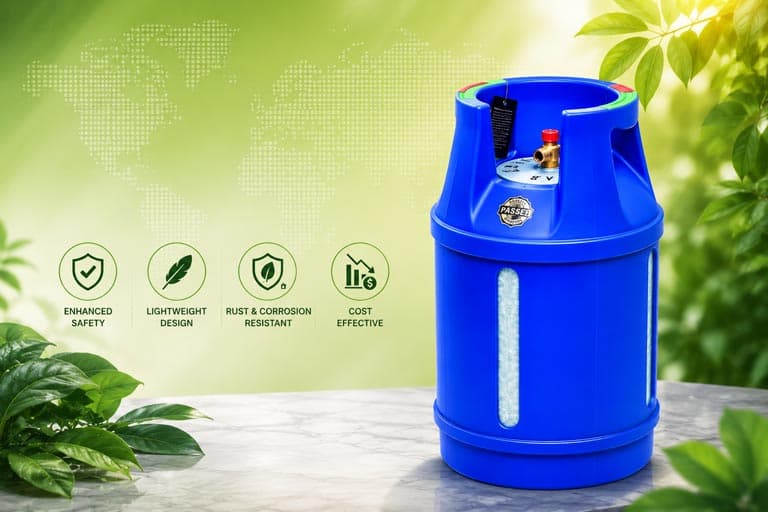
Pakistan's structural LPG import dependency creates a specific advantage argument for composite cylinders at the household level. A household that invests in a high-quality, 20+ year-life composite cylinder is insulating its cooking fuel infrastructure from cylinder hardware costs for two decades — the cylinder purchase is a one-time decision. Whether LPG import prices rise or fall, the cylinder itself is not the cost variable. Combined with the operational efficiency gain of level visibility (which reduces unnecessary refill deliveries), the composite cylinder maximises the value households extract from whatever the current LPG price is.
Frequently Asked Questions
Why does the LPG refill price change every month in Pakistan?
OGRA adjusts the Maximum Consumer Price for LPG monthly based on the previous month's Saudi Aramco Contract Price (CP), international shipping rates, port charges, import duties, and distribution margins. Since 60–65% of Pakistan's LPG is imported at this international price, domestic LPG costs are directly linked to global energy market movements that change every month.
Why can't Pakistan increase its domestic LPG production?
Domestic LPG production is constrained by the rate of natural gas extraction from Pakistan's existing gas fields, most of which are mature and in decline. Domestic LPG production can only increase meaningfully through new gas field discoveries and development — a long-lead, capital-intensive process. Pakistan's E&P investment environment has limited new field development in recent years, meaning import dependency is expected to persist and potentially deepen through 2030.
Does the Pakistan government subsidise LPG prices?
Pakistan has historically applied limited direct subsidies to LPG prices for household consumers, primarily through relief packages for low-income households during periods of extreme price spikes. The primary mechanism for price management is OGRA's monthly MCP calculation, which incorporates a regulated margin structure that limits what distributors and retailers can charge above their actual cost base. Direct price subsidies are occasional and limited in scale compared to the subsidies historically applied to pipeline gas (Sui gas).
Is Pakistan's LPG shortage in winter caused by import supply problems or domestic distribution?
Pakistan's winter LPG shortage is primarily a domestic distribution and capacity constraint — not a failure of import supply. LPG imports continue year-round at relatively consistent volumes. The winter shortage results from: demand spikes that exceed distribution infrastructure capacity (trucking, storage); priority dispatch to industrial and commercial customers; and dealer stock management that does not scale up early enough for the winter demand surge. Households with a full composite cylinder and one refill in reserve are insulated from distribution bottlenecks regardless of their cause.