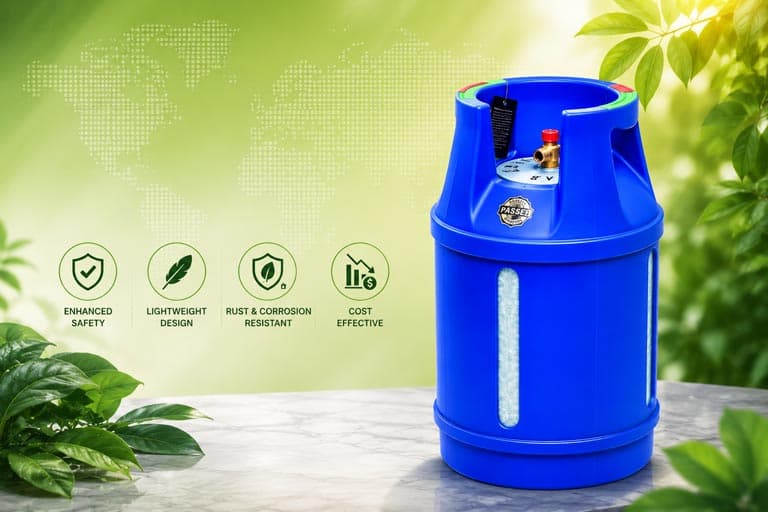
Every winter, millions of Pakistani households face acute gas shortages. Here is how to prepare your home before the cold hits — and why an LPG composite cylinder is the most reliable backup you can have.
Key Takeaways
- ✓Pakistan loses functional pipeline gas pressure for 3–4 months every winter — this is structural, not accidental
- ✓Lahore, Faisalabad, Peshawar, and rural KPK are the hardest-hit regions each year
- ✓LPG is the only backup completely independent of the pipeline network and electricity grid
- ✓Composite cylinders are non-blast — safe for winter heating use even near open flame sources
- ✓Start preparing in August–October before panic buying empties dealer shelves in November
It is 4:30 in the morning in Lahore. Fajr is 40 minutes away. In the kitchen, someone turns the gas stove knob. There is no click of ignition, no blue flame, no hiss of gas. The pressure is so low that not even a lighter held directly to the burner produces a flame worth cooking on. This scene repeats itself in millions of Pakistani homes every winter — from Peshawar to Gujranwala, from Rawalpindi to Faisalabad. Mothers trying to prepare Sehri in cold kitchens. Children going to school without a hot breakfast. Elderly people unable to heat their rooms. The winter gas shortage in Pakistan is not a minor administrative inconvenience. For the households it affects most severely, it is a daily ordeal that lasts three to four months of every year.
The winter gas shortage Pakistan 2025 season will be no different from those that preceded it. In fact, with domestic gas field production continuing its multi-year decline and demand growing every year as more households connect to the gas network, the 2025 winter shortage may be more severe than previous years. The government will issue advisories. SNGPL will announce load management schedules. Journalists will file the same stories they filed last December. And millions of households will wake up to cold stoves unless they have prepared in advance.
This guide gives you a complete, specific, actionable plan for preparing your home for the winter gas shortage before it begins. It covers why the shortage happens, which areas suffer most, why LPG is the only reliable backup, how to choose the right cylinder, when to do each preparation step, and how to manage safely through the peak shortage months. If you are also concerned about Pakistan's wider LPG shortage problem and how composite cylinders help address it, that guide explains the full picture. Read this one now, in summer, while you still have time to act.
A Brief History: Why Pakistan's Winter Gas Shortage Never Goes Away
Pakistan's natural gas pipeline network was designed and built primarily in the 1960s and 1970s, when the country had a population of approximately 50–60 million people and residential gas connections were limited to a small proportion of urban households in major cities. The infrastructure was sized for the demand of that era. Since then, Pakistan's population has grown to over 230 million, the urban population has expanded dramatically, and the number of residential gas connections has grown from hundreds of thousands to over ten million.
The pipeline capacity, however, has not grown proportionally. Investment in transmission and distribution infrastructure has consistently lagged demand growth. The result is a system designed for a much smaller consumer base now trying to serve a vastly larger one — and failing, with mathematical certainty, every winter when peak demand pushes total consumption beyond what the network can physically deliver.
Successive governments have recognised this gap and announced infrastructure expansion programmes. Some progress has been made — new transmission lines in parts of KPK, LNG terminal capacity in Karachi. But the pace of infrastructure development consistently lags demand growth. Each year, the gap between what the pipeline can deliver in winter and what consumers demand grows slightly wider. The shortage gets slightly more severe. And every spring, when demand drops back to summer levels, the crisis appears to resolve — only to return the following November.
The Science Behind the Winter Shortage: Why Cold Weather Multiplies the Problem
The winter gas shortage is not simply a matter of using gas to heat rooms in addition to cooking. The underlying thermodynamics of the natural gas network itself makes winter demand spikes disproportionately severe. Gas pipelines operate under pressure. At low demand, high pressure allows gas to flow rapidly through the network and maintain pressure at all endpoints. As demand increases and more gas is withdrawn from the network simultaneously, pressure falls throughout the system. When pressure drops below a certain threshold, domestic appliances — particularly cooking stoves and water heaters — cannot draw sufficient gas to function properly.
This pressure collapse is not linear. As household after household fires up a gas heater in addition to the usual cooking load, withdrawal rates across the network spike sharply. Because the pipeline has finite pressure capacity, these withdrawals compete with each other. Households at the end of distribution networks — those furthest from gas injection points — lose pressure first and most severely. This is why Lahore (at the far end of SNGPL's northern network) experiences worse shortages than Rawalpindi (closer to the network's injection points), and why suburban areas suffer more than city centres served by higher-pressure distribution mains.
The winter demand surge is also not just about heating. Pakistani cooking patterns change in winter: longer meals, richer dishes, more fuel-intensive preparations like slow-cooked daal mash, halwa, and winter specialities that require extended burner time. Evening family gatherings around the dinner table in winter are longer and more elaborate than summer equivalents. Every additional minute of burner use per household, multiplied across ten million connections, adds up to enormous incremental demand that the network cannot accommodate.
The Domestic Gas Production Decline Making It Worse
Compounding the infrastructure capacity problem is the steady decline in Pakistan's domestic natural gas production. Pakistan's major gas fields — Sui in Balochistan, Qadirpur and Kandhkot in Sindh, Mari and Sawan — have been producing for decades and are in structural decline. OGDCL's gas production volumes have fallen consistently year-on-year since approximately 2012. New field discoveries and development have not kept pace with depletion from mature fields. The result is that the total gas available to inject into the pipeline network is shrinking at the same time that the number of household connections demanding that gas is growing.
Pakistan supplements declining domestic production with Re-gasified Liquefied Natural Gas (RLNG) — imported LNG that is vaporised at terminal facilities in Karachi and injected into the national pipeline grid. However, RLNG is expensive, denominated in foreign exchange, and subject to global LNG market volatility. During periods of high global LNG demand — as experienced during the 2021–2022 post-COVID energy crisis and the 2022–2023 Russia-Ukraine supply disruption — Pakistan competed against wealthier buyers for spot LNG cargoes and sometimes lost, resulting in reduced RLNG availability precisely during peak winter demand periods. The foreign exchange constraints that have periodically gripped Pakistan's economy further limit the country's ability to maintain adequate RLNG import volumes.
Which Cities and Areas Suffer Most — and Why
Lahore: Pakistan's second largest city is consistently the hardest hit by winter gas shortage. Its position at the far northern end of SNGPL's transmission network means pipeline pressure reaches it last and at lowest levels. With a metropolitan population exceeding 13 million, the aggregate demand from millions of simultaneous morning cooking and heating sessions produces catastrophic pressure drops across the city's distribution network. Suburban areas — DHA, Bahria Town, Johar Town, Gulberg periphery — routinely lose functional gas pressure by November.
Faisalabad and Gujranwala: Pakistan's industrial heartland cities experience both pipeline gas and LPG shortages simultaneously — pipeline gas pressure drops force households to LPG backup, and the sudden surge in LPG demand from millions of households simultaneously seeking backup supplies outstrips LPG dealer stocks within days.
Rawalpindi and Islamabad: Being closer to SNGPL's northern injection points, these cities experience less severe pressure drops than Lahore — but the combination of colder temperatures (elevation) and the heating demand of government buildings and military installations competes with household supply.
Peshawar and KPK: Khyber Pakhtunkhwa's pipeline gas coverage is thinner than Punjab's, with many areas depending entirely on LPG. Winters are colder, heating demand is higher, and the LPG distribution infrastructure is less developed. Shortage durations in KPK can exceed those in Punjab by weeks.
Karachi: Served by SSGCL rather than SNGPL, Karachi experiences less severe pipeline gas shortage than Punjab and KPK. However, LPG supply disruptions affect Karachi households that rely on LPG for cooking, and winter demand spikes from the city's large migrant population can stress LPG dealer stocks.
The Human Cost of Being Unprepared
The winter gas shortage is not merely inconvenient. For the households it strikes hardest, it has real, measurable human costs. Children who cannot have hot breakfasts before school in January perform worse academically — research on child nutrition and cognitive performance is unambiguous about the importance of morning caloric intake. Women managing households without reliable cooking gas face severe time stress, often spending hours sourcing alternative fuel or queuing at LPG dealers while simultaneously managing childcare and household responsibilities. Elderly people without reliable gas heating face real health risks from cold exposure — Pakistan's hospitals see spikes in cold-related respiratory and cardiovascular presentations every January.
Families that resort to charcoal or wood burning as an emergency alternative face indoor air quality risks that are well-documented: particulate matter from wood combustion is a leading cause of chronic respiratory disease in Pakistan, and the transition back to biomass cooking during winter gas shortages effectively reverses the health gains that pipeline gas connection originally delivered. Getting prepared for the shortage is not just a convenience choice — it is a health and family welfare decision.
Why LPG Is the Only Truly Reliable Winter Backup
When the pipeline gas pressure drops, households in Pakistan have a limited range of practical backup options. Electricity-based cooking — induction cooktops, electric stoves — is unavailable to the millions of households that simultaneously face winter load shedding alongside the gas shortage. The two crises, unfortunately, peak at the same time: winter demand strains both the gas network and the electricity grid simultaneously, making electric cooking a doubly unreliable backup.
Wood and charcoal are regressive options — they produce indoor air pollution, require sourcing and storing solid fuel, and create fire risks. Kerosene is expensive, produces fumes, and its retail availability has declined significantly as the LPG market expanded. Biogas is available to rural households with sufficient cattle, but not to urban and peri-urban families.
LPG stored in a pressurised cylinder is the only backup cooking fuel that is: immediately available (valve open, flame lit, cooking begins in seconds); completely independent of the electricity and pipeline gas networks; clean-burning with no indoor air quality concerns; portable and convenient to store and handle; and available through a nationwide dealer network. For every Pakistani household at risk of winter gas shortage — which is to say, any household connected to SNGPL or SSGCL in Punjab, KPK, or parts of Sindh — LPG backup is not a luxury option. It is the sensible, practical, necessary preparation for a shortage that will come.
Composite vs Steel: Why the Cylinder Choice Matters in Winter
Cold Weather LPG Vaporisation Performance
LPG is stored in a cylinder as a liquid under moderate pressure. For your stove to work, this liquid LPG must vaporise at the top of the cylinder — converting from liquid to gas phase — before passing through the regulator and burner. This vaporisation process is temperature-sensitive: as ambient temperature drops, the rate of LPG vaporisation slows, and in very cold conditions a cylinder can struggle to deliver gas fast enough for a high-demand cooking session. This is a real phenomenon that Pakistani households in cold areas — particularly elevated parts of Punjab and KPK — experience on the coldest January mornings, especially with large steel cylinders that have been sitting outside overnight.
WAATechnologies composite cylinders have an HDPE outer shell that provides modest but meaningful thermal insulation compared to bare steel. The HDPE does not conduct heat as readily as metal, which slightly slows the rate at which cold ambient air chills the liquid LPG inside. This means composite cylinders maintain better gas delivery performance in cold conditions than steel equivalents. Additionally, the lighter weight of composite cylinders makes it entirely practical to bring them indoors or into a sheltered area during the coldest nights — something that is physically difficult with heavy steel cylinders.
Weight: Critical for 5 AM Cylinder Swaps
Winter gas shortage creates situations where cylinders need to be swapped at inconvenient times — early morning Sehri preparation, late at night when the gas runs out unexpectedly, or when a household member who is not the usual designated cylinder-handler needs to manage it alone. A fully filled steel LPG cylinder weighs 27–28 kg. For a woman alone in the kitchen at 4:30 AM, or an elderly person, or any adult managing this without help, handling a 27 kg cylinder is difficult and potentially dangerous — straining backs, risking drops, making the whole cylinder-swap process something that requires planning and assistance.
A fully filled WAA composite cylinder weighs 17–20 kg, depending on size. This is a weight any adult can handle comfortably, without assistance, without strain, even at 4:30 in the morning while tired and fasting. The difference in practical usability during the real-world conditions of a winter shortage is significant — and for the households where this is most relevant (elderly members, women managing alone, households without a strong adult male member available at all times), it can be the difference between successfully managing the shortage and struggling with it daily.
Non-Blast Safety in Winter Heating Contexts
Winter shortage conditions push households to use LPG in ways they would not during normal periods. Cylinders are sometimes placed closer to heating elements to try to warm them. Improvised heating setups are deployed. Gas heaters are used in smaller, more enclosed spaces to preserve warmth. These are the conditions under which the safety properties of the cylinder matter most — and the difference between a composite and steel cylinder is most consequential.
WAATechnologies composite cylinders are non-blast by design. Under extreme heat exposure — whether from a nearby heater, a kitchen accident, or a fire — the glass fibre composite shell degrades and allows the cylinder to vent gas through developing permeation rather than rupturing catastrophically. A steel cylinder in the same situation is a shrapnel bomb: it absorbs heat, internal pressure builds, and when the structural limit is reached, it explodes with lethal force. Pakistani fire and rescue services respond to steel LPG cylinder explosions multiple times per year, particularly in winter when shortage-driven desperation leads to unsafe usage patterns. The non-blast guarantee of a composite cylinder eliminates this risk category entirely.
See-Through Level Monitoring: Never Run Out at 5 AM
Running out of gas at 5 AM during Sehri preparation, with no dealer open and no backup, is one of the most frustrating experiences a Pakistani household can face during winter shortage. Steel cylinders give no indication of their contents until they run empty — experienced users shake them, lift them, or tap them to estimate level, but these methods are imprecise and frequently wrong. WAA composite cylinders have a translucent HDPE body that allows you to see the LPG level directly, like looking at a water bottle. A daily 3-second glance tells you exactly how much gas remains. You can plan your refill when the level drops to one-quarter, weeks before you are in danger of running out — rather than discovering the cylinder is empty at the worst possible moment.
20+ Year Service Life: One Purchase, Two Decades of Winter Security
A steel cylinder used as a winter backup will need replacement after 8–12 years, often earlier in Pakistan's climate if stored outdoors. Corrosion at the base, valve seat, or body seam eventually requires the cylinder to be retired. A WAA composite cylinder, with its corrosion-immune HDPE and fiberglass construction, maintains its structural integrity and service performance for 20+ years. The composite cylinder you purchase this August will be ready for winter 2045 in the same condition it is in today. Across two decades of winter preparation, you make one cylinder purchase rather than two. That is a lower total cost of ownership despite the higher initial price — and two decades of non-blast safety and convenience rather than one.
Month-by-Month Preparation Calendar: What to Do and When
August — Research and Decide
August is the ideal month to begin winter preparation. LPG dealer shelves are fully stocked, prices are not yet inflated by shortage-season demand, and you have months before the shortage begins. Use August to locate your nearest WAATechnologies authorised dealer, decide on the right cylinder size for your household (10 kg for a family of 4–6, 12 kg for larger families or combined cooking and heating use), and understand the full setup you will need: cylinder, regulator, high-quality hose, and possibly a single-burner gas stove if your current stove is pipeline-only.
September — Purchase and Install
Purchase your composite cylinder or cylinders in September and arrange professional installation by a qualified gas technician. The technician will correctly fit the regulator, ensure the hose is properly connected and of appropriate length, and verify the complete system for leaks using a soap solution test. This is not a step to skip — an improperly installed LPG connection is a gas leak risk, and September is the time to get it done correctly, calmly, and without the pressure of an ongoing shortage.
October — Test, Stock, and Save Your Dealer's Number
By October, gas pressure in many Punjab areas begins showing early-morning dips. Test your LPG backup system under realistic conditions — light the stove, run a full cooking session, verify gas flow at different burner settings. If you plan to keep two cylinders (strongly recommended), fill the second cylinder in October while dealer turnaround is still fast. Dealer refill times that are 24 hours in September can stretch to 3–5 days by December as shortage-driven demand overwhelms dealer capacity. Getting your second cylinder filled in October avoids this queue. Also in October: save your dealer's contact number in your phone and establish yourself as a regular customer. Dealers prioritise regulars during shortage rationing.
November — Service Appliances and Complete Safety Setup
November is the last comfortable month before the shortage peaks. Use it to complete all appliance maintenance: have your gas stove burners cleaned and jets checked by a technician (partially blocked jets cause yellow flames and carbon monoxide production, which becomes dangerous in enclosed winter kitchens); replace your regulator hose if it is more than two years old; inspect the regulator itself for wear or damage; install a carbon monoxide detector in your kitchen and in any room where you use a gas heater. By the end of November, your preparation should be complete. December is not the time to be sourcing a technician — they are fully booked from November onwards.
December Through February — Active Shortage Management
During the shortage peak, your preparation pays off. Monitor your composite cylinder level with a daily visual check — the translucent body makes this a 2-second task. Reorder from your dealer when the primary cylinder reaches one-quarter full. Do not wait until the cylinder empties — in peak shortage months, dealer refill queues can mean a 2–4 day wait, and you cannot afford to be without gas for that period during January. When the first cylinder is refilling, your backup cylinder keeps the household cooking continuously. Maintain the cylinder valve shutdown habit: close the valve after every cooking session, every night, and whenever you leave the house for an extended period.
Appliance Maintenance: The Overlooked Preparation Step
An LPG backup system that works perfectly is useless if the gas stove it connects to is in poor condition. Many Pakistani gas stoves are used for years without maintenance — burner jets gradually block with food residue and grease, burner caps become misaligned, and ignition systems degrade. These conditions, which are merely annoying with adequate pipeline gas pressure, become significant problems with LPG: partially blocked jets running on LPG may produce incomplete combustion, generating carbon monoxide in quantities that are hazardous in the closed winter kitchen environment.
Before November, have all stove burners cleaned. Remove the burner caps and jets, soak in warm soapy water, scrub with a soft brush, and use a fine pin to clear any blocked orifice. Ensure burner caps are correctly aligned and seated after cleaning — a tilted burner cap creates uneven flame distribution that indicates incomplete combustion. Confirm that all four burners (or however many your stove has) produce clean blue flames when lit on LPG — a yellow or orange flame indicates either a blocked jet or an air-to-gas mixture problem that needs technician attention.
Check the regulator hose along its entire length: it should be flexible (not stiff or brittle), free of cracks or swelling, correctly secured at both connection points, and not kinked or compressed anywhere. If the hose has been installed under a stove or behind a cabinet where it could have been trapped or kinked, pull it out and inspect carefully. A cracked or kinked hose is the most common source of gas leaks in domestic LPG setups and should be replaced before it causes an incident.
The Carbon Monoxide Danger in Winter — Read This Carefully
Carbon monoxide (CO) is a colourless, odourless gas produced when LPG or any hydrocarbon fuel burns incompletely. Incomplete combustion occurs when insufficient oxygen is available for complete burning — which happens in poorly ventilated rooms, with dirty or misaligned burner jets, or when gas pressure is insufficient for the full combustion air supply the burner requires. In a well-ventilated summer kitchen with windows open, trace CO production from minor burner inefficiency disperses harmlessly. In a winter kitchen with windows closed against the cold, running multiple burners for extended Sehri or Iftar preparation, CO can accumulate to dangerous levels.
Symptoms of CO exposure in order of increasing severity: headache, dizziness, and fatigue (which can easily be attributed to fasting or tiredness), progressing to nausea and confusion, and at high concentrations, loss of consciousness. CO poisoning can be fatal. The tragedy is that it is entirely preventable: keep a window cracked even in cold weather during extended cooking, run an exhaust fan if available, and install a CO detector near gas appliances. CO detectors are available for modest cost and alarm at concentrations well below dangerous levels — giving you time to ventilate and exit safely before a problem becomes an emergency.
Never use an LPG room heater in a completely sealed room overnight. If you use an LPG heater to warm a room before sleeping, turn it off and ventilate the room before sleeping. CO produced by overnight heater operation in a sealed room can kill silently — this is the cause of multiple fatalities in Pakistan every winter.
How Much LPG Will Your Household Need This Winter?
Understanding your household's LPG consumption helps you plan buffer stock correctly. A family of five using LPG only for cooking backup (not heating) typically consumes 0.3–0.5 kg of LPG per day during regular cooking. A 10 kg cylinder at this consumption rate lasts approximately 4–6 weeks. For a winter shortage lasting November through February (approximately 16 weeks), you would cycle through approximately 3–4 cylinder fills. Having a second cylinder as backup means you need to arrange approximately 2 refills per cylinder over the shortage period — manageable if planned in advance, stressful if reactive.
If you plan to use LPG for heating as well as cooking, multiply your consumption estimate significantly. A gas room heater running 6 hours per day consumes 1.5–2.5 kg of LPG daily. A household using LPG for both cooking and heating through January and February could consume a 10 kg cylinder in 3–5 days. For these households, a 12 kg cylinder and a very active refill schedule — or multiple cylinders — is essential planning.
Complete Winter Gas Shortage Preparation Checklist
- August: Locate nearest WAATechnologies authorised dealer; decide on cylinder size (10 kg or 12 kg); budget for purchase
- September: Purchase composite cylinder(s) and matched regulator; arrange professional installation; soap-test all connections
- October: Test LPG system with full cooking session; fill second backup cylinder; save dealer contact in phone
- November: Service all stove burners (clean jets, check burner caps); replace hose if over 2 years old; install CO detector in kitchen and heated rooms; confirm both cylinders are full
- December–February: Visual cylinder level check daily using translucent composite body; reorder when primary cylinder at one-quarter level; never let both cylinders run low simultaneously
- Every cooking session: Close cylinder valve when finished; do not leave gas flowing through regulator when stove is not in use
- Every night: Confirm cylinder valve is closed before sleeping
- When leaving home for Taraweeh or extended absence: Close cylinder valve; ensure no burner is left alight
Frequently Asked Questions
When does the winter gas shortage usually start in Pakistan in 2025?
Based on recent years, household pipeline gas pressure begins dropping noticeably in late October and early November in Lahore, Faisalabad, and Gujranwala. By December, serious shortage conditions typically prevail across most of Punjab and KPK. The shortage peaks in January and February and begins easing in March as temperatures rise and heating demand drops. Preparation should be complete by November at the latest — ideally by October.
What size WAA composite cylinder is right for my family?
For a family of 4–6 using LPG for cooking backup only: two 10 kg cylinders (one primary, one backup) is the optimal setup. For larger families or households planning LPG heating use: two 12 kg cylinders, with active refill management. For smaller households or apartments where storage space is limited: one 10 kg and one 5 kg provides primary use plus a smaller emergency backup.
Can I use the composite cylinder with my existing SNGPL-connected stove?
Most Pakistani gas stoves are designed for natural gas but can typically be adapted for LPG use by changing the burner jet orifice to a smaller LPG-specification size — LPG has higher calorific value and requires a smaller orifice than natural gas. A qualified gas technician can perform this conversion. Alternatively, a dedicated single-burner or two-burner LPG stove is an inexpensive addition that provides a completely separate LPG cooking point without any modification to your existing pipeline-connected stove.
Is it safe to store an LPG cylinder indoors in winter?
Cylinders should ideally be stored in ventilated outdoor or semi-outdoor areas (a covered veranda or utility room with ventilation). In winter, bringing a composite cylinder indoors temporarily to warm it slightly before early morning use is acceptable if the room is ventilated. Never store cylinders in basements, sealed cupboards, or unventilated rooms. Always close the cylinder valve — not just the stove knob — when not actively cooking.
Conclusion: The Prepared Household Never Suffers a Winter Shortage
Pakistan's winter gas shortage will arrive in 2025 exactly as it has every year for the past two decades. It will cause suffering for unprepared households and be a minor background inconvenience for prepared ones. The difference between those two experiences is determined entirely by whether preparation happens in August and September or is postponed until the shortage is already underway in December. The prepared household — with two WAA composite cylinders installed, stove serviced, CO detector in place, and dealer contact saved — will cook hot meals every morning of winter without interruption, regardless of what SNGPL's gas pressure does. That household security is available to every Pakistani family. The only question is whether you act now, while you have time to do it properly, or wait until the shortage makes every step harder.
WAATechnologies Pvt Ltd manufactures composite LPG cylinders to ISO 11119-3 and EN 14427-2022 standards at their Gujranwala facility. Available in 5 kg, 10 kg, and 12 kg sizes through authorised dealers across Punjab, Sindh, and KPK. Contact us at (+92) 4237815533 or visit 172-A First Floor, Adjacent Bahria Grand Masjid, Sector E Commercial Bahria Town Lahore. Visit our shop today and make your home winter-ready.