5 specific warning signs that your LPG cylinder or connection is dangerously unsafe — each explained with what to look for, what it means, and the exact steps to take immediately. Includes the most-ignored sign that causes most Pakistani kitchen fires.
5 Warning Signs at a Glance
- ⚠1. A gas smell anywhere in the kitchen, however faint
- ⚠2. Visible rust, dents, or damage on the cylinder body
- ⚠3. A cylinder valve that does not turn fully closed
- ⚠4. Irregular stove flame — too high, too low, or flickering unpredictably
- ⚠5. A hissing sound from the cylinder, regulator, or hose connection
Pakistani households live with LPG cylinders as a completely normal part of domestic life. The cylinder in the kitchen corner is as familiar as the refrigerator or the washing machine — and, like familiar objects, it is easy to stop noticing it. This familiarity is one of the reasons gas cylinder accidents are so common in Pakistan: the warning signs that a cylinder or connection is becoming dangerous are present for days or weeks before an incident, and they are simply not recognised as danger signals by families who have lived with LPG all their lives without a problem.
These are the five warning signs that demand immediate action. Each sign is described with what specifically to look for, what the underlying problem is likely to be, and the exact steps to take — including what not to do, which is often more important than what to do.
Warning Sign 1: Any Gas Smell in the Kitchen
The most important warning sign is also the most commonly dismissed. LPG is odourised with ethyl mercaptan — the rotten egg or pungent sulphur-like smell added specifically so that leaks can be detected before the gas reaches its explosive concentration. The odorant is calibrated to be detectable at concentrations well below the Lower Explosive Limit of 1.8% in air. This means: if you can smell gas, the concentration in your kitchen is approaching a level that can ignite.
Pakistani households frequently explain away a faint gas smell: "it's just when we first turn on the stove," "it always smells a little bit here," "the neighbours' kitchen sometimes smells." These explanations are always wrong. A functioning LPG system with a gas-tight connection and properly operating appliances has zero gas smell. Any gas smell, at any time, in any concentration, means gas is escaping somewhere it should not be.
What to do: Close the cylinder valve immediately. Open every window and door in the kitchen and adjacent rooms. Do not operate any electrical switches (on or off) — even a light switch creates a spark that can ignite gas at the right concentration. Evacuate the kitchen. Allow the space to ventilate for at least 15 minutes. Then perform the soap-and-water bubble test on every connection point before using the gas again. If you cannot identify and resolve the source of the smell, call your LPG dealer or a qualified gas technician.
What not to do: Do not attempt to find the leak with a lighter or match. Do not use the stove while the smell is present. Do not leave the kitchen assuming the smell will "go away on its own."
Warning Sign 2: Visible Rust, Dents, or Physical Damage on the Cylinder
A conventional steel LPG cylinder is a pressure vessel. Its safe operating pressure depends on the structural integrity of the cylinder walls. Corrosion thins those walls. Dents create stress concentrations where cracks initiate. Deep impact damage can deform the cylinder body in ways that alter its pressure-bearing geometry. Any of these physical changes reduces the cylinder's safety margin — sometimes below the level needed to contain the pressure of a full cylinder on a hot Pakistani summer day.
Specifically, look for: orange or red surface rust on any part of the cylinder body (including underneath, where cylinders rest on the floor and where condensation accumulates); rust or white mineral deposits around the base of the valve (indicating moisture ingress); dents deeper than approximately 5 mm or wider than 50 mm anywhere on the cylinder body; and any dents or deformation near or on the valve collar (the metal ring around the valve at the top of the cylinder).
What to do: A cylinder with heavy rust, visible dents near the valve, or any impact damage to the valve itself should be taken out of service immediately. Contact your LPG dealer for a safe exchange or disposal. Do not attempt to continue using a damaged cylinder "until it runs out."
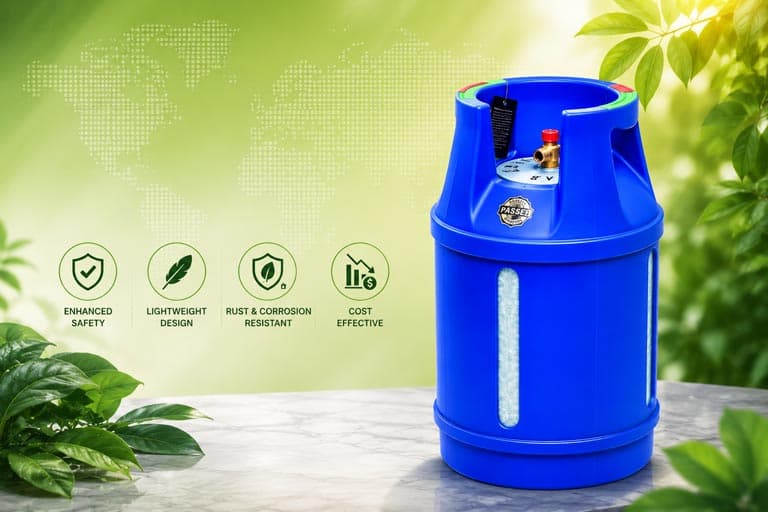
Note for composite cylinder owners: This warning sign does not apply in the same way to WAA Technologies composite cylinders — the HDPE and glass fibre body cannot rust. Minor surface scratches on a composite cylinder are cosmetic and do not affect structural integrity. Significant impact damage (cracks in the HDPE body, visible delamination of the fibre layer) is a warning sign, but it is far rarer and more visually obvious than the subtle internal corrosion that makes old steel cylinders unpredictable.
Warning Sign 3: A Cylinder Valve That Will Not Fully Close
The cylinder valve is the primary safety barrier between the pressurised gas inside the cylinder and the outside environment. When you close the cylinder valve by turning it clockwise, gas flow should stop completely — verifiable by the fact that even after you turn off the stove burners, the regulator pressure gauge (if you have one) shows no pressure drop, and there is zero gas smell. A valve that will not turn to a firm stop, that feels loose or gritty when turned, or that, when "closed," still allows gas to flow to the stove (you can still light the stove after closing the valve, as the residual gas in the hose allows a brief flame) may not be fully sealing.
Valve closure failures in Pakistan are most commonly caused by corrosion of the valve stem and seat (preventing the valve plug from seating fully against the valve body), mechanical wear from repeated operation, grit or debris on the valve seat, and physical damage from impact. A valve that cannot fully close is a continuous gas leak — it leaks slowly at all times, even when the cylinder is "closed," and will accumulate gas in any enclosed kitchen over time.
What to do: If the cylinder valve does not reach a firm stop with reasonable hand pressure, or if the valve feels abnormal in any way, have the cylinder inspected by your LPG dealer. Do not store a cylinder with a defective valve in an enclosed space. A cylinder with a valve that cannot be fully closed should be removed from use and reported to your dealer for safe disposal.
Warning Sign 4: Irregular Stove Flame Behaviour
Your stove flame is a visible indicator of gas pressure delivery from the cylinder through the regulator. A properly functioning LPG setup produces a steady, consistent blue flame at each burner that responds predictably to the stove knob. Irregular flame behaviour can indicate multiple problems in the gas delivery chain, some of which have safety implications.
Look for: a flame that is unusually large and orange/yellow rather than blue (over-pressure from a faulty regulator); a flame that fluctuates in size independently of the stove knob (inconsistent pressure delivery — possible regulator diaphragm failure); a flame that cannot be turned down to a low simmer despite turning the knob to its lowest position (regulator pressure not reducing); or a flame that suddenly extinguishes at low settings but works normally at high settings (regulator cut-off mechanism malfunction). Any of these indicates a regulator problem rather than a cylinder problem — but a faulty regulator is a safety concern because it can deliver gas at the wrong pressure and because a failed regulator diaphragm can allow gas to escape from the regulator body.
What to do: A regulator showing these symptoms should be replaced — not adjusted or repaired. Regulators cost Rs. 800–2,000 from authorised LPG dealers. This is not an expensive fix for a device that controls the pressure of flammable gas in your kitchen.
Warning Sign 5: Hissing Sound from the Cylinder, Regulator, or Hose
A hissing sound in the vicinity of your LPG setup is a gas leak in progress. The sound is produced by pressurised gas escaping through a small aperture — a cracked hose, a loose regulator connection, a damaged valve, or a corroded fitting. The hissing may be faint and intermittent, particularly from a small leak that is temperature-sensitive (expanding when the kitchen is warm, contracting and slowing when cool). Any hissing sound from any component of your LPG setup is an immediate evacuation trigger — not something to investigate more closely by putting your ear nearer to the sound.
What to do: Close the cylinder valve immediately and fully. Do not touch any electrical switches. Open windows and doors. Evacuate everyone from the kitchen. Call your LPG dealer from outside the building. Do not re-enter until the leak has been professionally identified and repaired.
The Warning Sign Pakistani Households Miss Most: Slow Hose Degradation
Beyond the five main warning signs, there is one additional sign that Pakistani households almost universally miss: hose degradation. The rubber or reinforced PVC hose connecting the regulator to the stove hardens, cracks, and becomes brittle over time — typically within 2 years in Pakistan's temperature extremes and UV environment. A hose that appears undamaged on the outside may have micro-cracks on the inside that leak under pressure. The OGRA-recommended hose replacement interval is every 2 years regardless of visible condition. If your hose has been in use for more than 2 years, replace it now — it costs Rs. 300–600 and is the cheapest safety upgrade available for your LPG setup.
Frequently Asked Questions
How do I test if my LPG cylinder is leaking?
The soap-and-water bubble test is the reliable household method. Mix washing-up liquid with water to create a thick foam. With the cylinder valve open and the stove burners closed, apply the foam generously to: the regulator-to-valve connection; both hose fittings; the stove inlet. Watch for growing or rhythmically popping bubbles — these indicate gas escaping at that point. No bubbles means no detectable leak. This test should be performed after every cylinder connection and periodically during normal use.
Is it safe to smell gas briefly when I first light the stove?
A very brief, faint smell of gas at the moment of lighting — lasting less than 1 second — can occur when residual unburned gas in the burner ignites. This is within normal limits. Any gas smell that persists after the burner is lit, that is detectable when the stove is off, or that you notice anywhere other than immediately at the burner when lighting, is not normal and should be investigated immediately using the procedure described under Warning Sign 1.
How old is too old for a steel LPG cylinder in Pakistan?
OGRA specifies that steel LPG cylinders must be hydrotested every 5 years. As a practical safety guideline for Pakistani households, a steel cylinder that is more than 10 years old should be retired regardless of its hydrotest status — the cumulative corrosion, mechanical handling, and fatigue cycling in Pakistani operating conditions make cylinders increasingly unsafe as they age. The manufacture date is stamped on the cylinder body — if you cannot read it, that itself is a warning sign.
What is the safest LPG cylinder for Pakistani households concerned about these warning signs?
A WAA Technologies ISO 11119-3 certified composite cylinder eliminates the two most common warning signs entirely: rust and physical degradation (impossible on a composite cylinder), and explosion risk (composite cylinders cannot BLEVE regardless of condition). The remaining warning signs — gas smell, valve closure, flame behaviour, hissing — apply to any LPG setup and should be monitored regardless of cylinder type. The composite cylinder eliminates the catastrophic outcome if a gas leak does occur — the result is a fire, not an explosion.