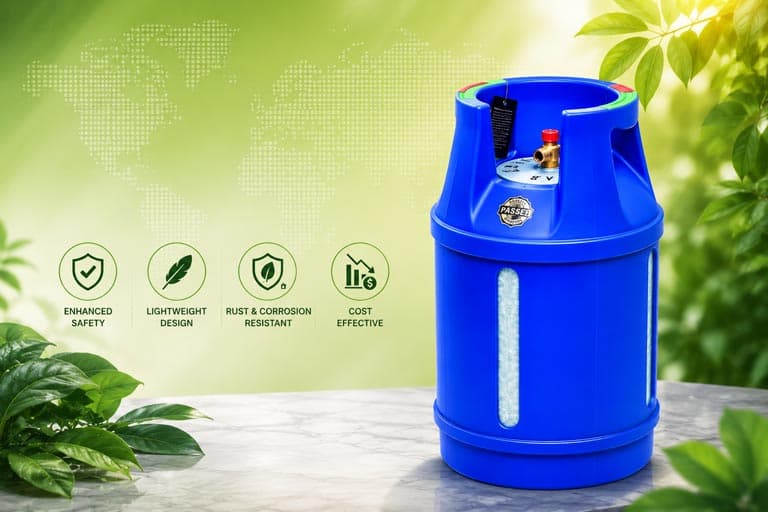
Understanding why LPG cylinders explode — BLEVE physics, valve failures, corrosion, overfilling — is the first step to preventing it. This guide explains the science in plain Urdu-context language and shows why composite cylinders physically cannot explode.
Key Takeaways
- ✓The technical name for a gas cylinder explosion is BLEVE — Boiling Liquid Expanding Vapour Explosion
- ✓Steel cylinder BLEVEs are caused by five root factors: corrosion, overfilling, heat exposure, faulty valves, and mechanical damage
- ✓Composite cylinders cannot BLEVE — their construction dissipates pressure through controlled leakage rather than rupture
- ✓The vapour from a leaking cylinder ignites at just 1.8–8.5% concentration in air — a much lower threshold than most people realise
- ✓A gas smell that persists after closing the cylinder valve means the leak is from the regulator, hose, or stove — not the cylinder body
Every Pakistani family that uses an LPG cylinder has likely heard the news reports: a cylinder exploded in a kitchen in Lahore, a blast destroyed a restaurant in Karachi, a family lost their home in Faisalabad after a cylinder blast during Sehri preparation. The incidents are distressingly common and the injuries catastrophic — for a detailed account, see the recorded gas cylinder blast incidents in Pakistan. Yet most Pakistanis have only a vague understanding of why cylinders explode — and without understanding the mechanism, it is impossible to make the specific decisions that prevent it. This article explains the physics of LPG cylinder explosions in plain language and shows, step by step, why composite cylinders eliminate the risk permanently.
What Is a BLEVE?
The technical term for an LPG cylinder explosion is a BLEVE: Boiling Liquid Expanding Vapour Explosion. Understanding the name explains the mechanism. LPG inside a cylinder exists in two phases: liquid at the bottom (under pressure) and vapour above it. The liquid is at a temperature above its atmospheric boiling point — it is only kept liquid by the pressure inside the cylinder. When that pressure is suddenly released — by a cylinder rupture — the liquid instantaneously flashes to vapour, expanding to approximately 250 times its liquid volume in microseconds. This explosive expansion is the BLEVE. The energy released shatters the cylinder container and propels fragments outward at high velocity while simultaneously releasing a large cloud of flammable vapour.
For a BLEVE to occur, two conditions must be present: sufficient energy must be stored in the liquid (which is always the case in a pressurised LPG cylinder at ambient Pakistani temperatures), and the containment must fail suddenly rather than slowly. This is why the integrity of the cylinder body and valve is so critical, and why any factor that weakens them moves the cylinder toward the conditions for a BLEVE.
The Five Root Causes of LPG Cylinder Explosions in Pakistan
Cause 1: Corrosion-Weakened Cylinder Walls
Pakistan's climate — high summer temperatures, monsoon humidity, coastal salt air in Karachi — aggressively corrodes steel. A steel cylinder develops external rust that pits and thins the cylinder wall over time. Internal corrosion from moisture contamination in refilled LPG and from acidic residues attacks the cylinder from inside. A cylinder wall that has been thinned by corrosion to below its design thickness no longer has the pressure rating printed on it. Under normal operating conditions or moderate heat exposure, a corroded cylinder can fail at pressures that a sound cylinder would handle safely.
Cause 2: Overfilling
LPG cylinders are designed to operate with a maximum fill of 80% of their water capacity — leaving 20% vapour space. This vapour space is essential: it accommodates the expansion of the liquid LPG as temperature rises. At 45°C (common in Pakistani summer conditions), LPG occupies approximately 12–15% more volume than at 20°C. Without vapour space, rising temperature increases cylinder pressure dramatically until the pressure relief valve opens — or, if the relief valve is stuck or absent, until the cylinder fails. Overfilling beyond 80% is done by some Pakistani dealers trying to deliver more LPG than a cylinder's licensed capacity, or by simple carelessness in manual filling operations.
Cause 3: Heat Exposure
Storing an LPG cylinder near a stove, in direct sunlight, or adjacent to any other heat source creates a positive feedback loop: heat raises the LPG temperature, which raises the vapour pressure, which increases the force trying to burst the cylinder. A sound cylinder with a functioning pressure relief valve can handle moderate heat exposure — the relief valve opens to vent excess pressure. But if the relief valve is corroded shut (common in old cylinders), or if heat input is very rapid (as in a kitchen fire), the pressure can exceed the relief valve's capacity and the cylinder fails.
Cause 4: Faulty or Counterfeit Valves
The cylinder valve has two critical safety functions: it closes to contain the LPG when the cylinder is not in use, and it contains a spring-loaded pressure relief device that opens to vent excess pressure before the cylinder reaches its failure pressure. A valve that cannot fully close (due to corrosion, grit, or wear) allows continuous slow leakage. A valve whose pressure relief is stuck closed (the most dangerous failure mode) means there is no safety pressure release — the cylinder builds to its structural failure point silently. Counterfeit valves manufactured without any quality control are particularly dangerous in this regard.
Cause 5: Mechanical Damage
Dropping a cylinder, striking it against a hard surface, or driving a vehicle over it can dent, crack, or deform both the cylinder body and the valve. A dented cylinder body has a stress concentration at the dent that can propagate under normal operating pressure cycling. A valve that has been struck can be bent so that it does not fully close, or its internal mechanism can be damaged such that the pressure relief no longer functions correctly. Pakistani LPG distribution chains involve rough handling — cylinders bouncing in trucks, being dropped from truck beds, stacked and knocked over at dealer premises. The accumulated mechanical damage on an older steel cylinder in circulation for 10+ years can be substantial.
Why Composite Cylinders Cannot BLEVE
The physics of the BLEVE requires a sudden, catastrophic failure of containment. This is only possible when the containment material can store and suddenly release elastic strain energy — which is a property of metals under tension. Steel at working pressure is storing significant elastic energy. When it fails, it releases that energy instantaneously, shattering the cylinder.
The glass fibre reinforcement in a composite cylinder works differently. Fibre reinforced composite materials fail in a progressive, energy-dissipating mode — not in the brittle fracture mode of overstressed metal. When a composite cylinder is over-pressurised, the fibres progressively delaminate and the liner develops a crack that grows slowly, releasing pressure as a controlled leak rather than a sudden rupture. The HDPE liner material has no elastic strain energy to release suddenly. The result is a gas leak that may ignite and burn — but not the shattering fragmentation event of a steel BLEVE.
This behaviour is not accidental — it is the specific engineering design intent of composite pressure vessels for LPG storage, and it is tested and certified under ISO 11119-3's fire engulfment and burst testing protocols. Every WAA Technologies composite cylinder sold in Pakistan has passed these tests and carries individual certification documentation proving non-blast behaviour.
How to Prevent LPG Cylinder Explosions in Your Home
- Store cylinders upright, away from stoves, heaters, and direct sunlight — always in ventilated spaces
- Never use a cylinder with visible rust, dents near the valve, or a valve that does not fully close
- Check the manufacture date — retire any steel cylinder over 10 years old regardless of appearance
- Perform the soap-and-water test after every connection to confirm no leakage
- Close the cylinder valve after every use — not just the stove knobs
- Switch to a certified composite cylinder — the only permanent, engineering-based solution to BLEVE risk
Frequently Asked Questions
Can a full LPG cylinder explode without fire?
Yes, but it is uncommon. A severely overfilled cylinder in high ambient temperatures can exceed its structural limit without external fire — this is pure pressure-failure rather than BLEVE. Far more commonly, a heat source is involved. The heat raises vapour pressure, the relief valve fails to open (or cannot vent fast enough), and the cylinder ruptures. Even without initial fire, the vapour cloud from a ruptured cylinder will almost certainly find an ignition source in a kitchen environment.
Why does LPG smell like rotten eggs?
Pure LPG (propane and butane mixture) is odourless. The rotten-egg or strong sulphur smell is added artificially by introducing ethyl mercaptan — a harmless chemical — specifically so that leaks can be detected by smell. Pakistan's LPG regulations require this odorant to be present at concentrations detectable well below the lower explosive limit of the gas. If you smell this odour, treat it as a definitive gas leak signal regardless of how faint it is.
At what gas concentration does LPG ignite?
LPG ignites in air at concentrations between 1.8% and 8.5% by volume — the Lower Explosive Limit (LEL) and Upper Explosive Limit (UEL). Below 1.8%, the mixture is too lean to ignite. Above 8.5%, it is too rich. The dangerous zone is the full range between these two values. In a closed Pakistani kitchen with a leaking cylinder, this concentration can be reached from a small leak within minutes. This is why immediate ventilation and valve closure — without operating any electrical switches — is the correct emergency response.
Is it safe to keep an LPG cylinder indoors in Pakistan?
A certified, sound cylinder with a proper connection and a closed valve is safe for indoor storage in a ventilated kitchen. LPG itself is not toxic — it is an asphyxiant in very high concentrations (displaces oxygen) but not a poison. The risk is ignition of leaked gas, not direct toxicity. Best practice is: keep the cylinder in a ventilated area, close the valve after every use, never store below ground level (LPG is heavier than air and will pool in basements or low spaces), and install a floor-level gas leak detector.