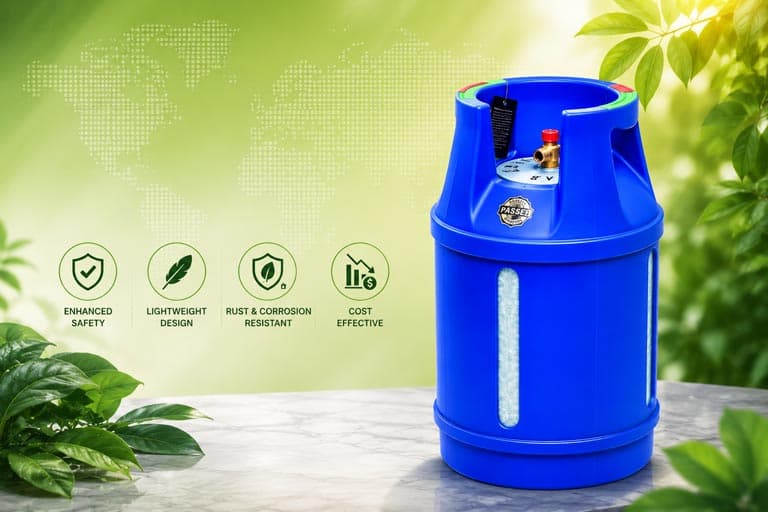
The traditional steel "gola" costs less upfront — but over 5 years, the composite fiber cylinder wins decisively on total cost. This detailed cost breakdown shows the real numbers for Pakistani households at current LPG prices.
5-Year Cost Verdict (10 kg cylinder)
Steel Gola — 5 Year Total
Rs. ~8,700
Includes hydrotest + possible replacement
Fiber Composite — 5 Year Total
Rs. ~10,500
No hydrotest. No replacement. Still in full service.
Cost difference narrows to ~Rs. 1,800 by year 5 — and composite continues earning back value in years 6–20 while steel requires another hydrotest and likely another replacement.
The single most common objection to buying a composite LPG fiber cylinder in Pakistan is: "it is too expensive compared to the steel gola." It is a valid concern — the upfront price difference is real, and for Pakistani households managing monthly budgets carefully, a Rs. 5,000–8,000 difference in purchase price is significant. But the objection assumes that the purchase price is the total cost, and that assumption is wrong. The total cost of owning an LPG cylinder includes the purchase, the periodic hydrotest (for steel only), replacement when the cylinder reaches end of life (for steel, much sooner than composite), and the operational costs that differ between the two types. This article does the full calculation for a Pakistani household over 5 years.
Understanding the Pakistani "Gola"
The term "gola" (literally "ball" or "round object") is the colloquial Pakistani name for the conventional steel LPG cylinder — named for its rounded shape. The gola has been the Pakistani household's primary LPG storage vessel for decades. It is heavy, opaque, prone to rust, and requires periodic professional testing to remain legally usable — but it has a price point that has made it the default choice for price-sensitive Pakistani households across all income levels. Understanding the gola's true economics reveals why the switch to fiber is financially rational even for budget-conscious households.
5-Year Cost Model: Steel Gola (10 kg)
Year 0 (purchase): Rs. 4,500 (authorised dealer price, 2025)
Year 5 (hydrotest): Rs. 700 (required under OGRA rules; cylinder must be pressure-tested at a licensed facility)
Subtotal at Year 5: Rs. 5,200
Expected cylinder condition at Year 5: Visible surface rust on a cylinder stored in a typical Pakistani kitchen environment. Valve seat showing early signs of corrosion. Cylinder structurally sound (assuming it passes the hydrotest) but visibly aged.
Additional steel-specific costs:
- The steel cylinder's opaque body means you have been estimating gas level by weight for 5 years — you have likely ordered 3–5 unnecessary refill deliveries that you didn't need. At Rs. 400–600 delivery fee per unnecessary call: Rs. 1,500–3,000 in avoidable costs over 5 years.
- The steel cylinder's weight (30+ kg when full) has required family members to struggle with it at every change and positioning — this is a real cost in physical effort and accident risk, not captured in money.
5-year total (excluding unnecessary delivery fees): Rs. 5,200
5-year total (including 4 unnecessary deliveries): Rs. 7,200–8,200
5-Year Cost Model: Composite Fiber Cylinder (10 kg)
Year 0 (purchase): Rs. 10,500 (WAA Technologies 10 kg, 2025 average)
Year 5 (maintenance): Rs. 0 (no hydrotest required; composite cylinder at year 5 is still within its 20+ year rated service life with no maintenance needed)
Subtotal at Year 5: Rs. 10,500
Expected cylinder condition at Year 5: Identical to when purchased. No rust possible. No corrosion. Valve clean. Body transparent and showing gas level at a glance — exactly as it did on day one.
Composite-specific savings:
- Zero unnecessary refill deliveries — you can see the gas level at any time. Conservative saving: Rs. 1,500–3,000 over 5 years.
- No hydrotest cost: Rs. 700 saved at year 5.
- No cylinder replacement needed through year 20: deferred cost saving of Rs. 10,500+ compared to steel's need for a new cylinder at year 8–12.
5-year total (cylinder hardware only): Rs. 10,500
5-year total minus unnecessary delivery savings: Rs. 7,500–9,000
Year 6–10: Where Composite Decisively Wins
At year 6, the steel gola owner faces the second hydrotest (Rs. 700 again) and an increasing probability of the cylinder reaching end of safe service life. Many steel cylinders in Pakistani conditions show significant corrosion and valve wear by years 8–10. A cylinder that fails its year-10 hydrotest, or one that a cautious owner retires at year 10 due to visible deterioration, requires a full replacement purchase: another Rs. 4,500–5,500.
At year 6, the composite fiber cylinder owner has the same cylinder they purchased at year 0 — in the same condition, with the same service life remaining, at zero additional cost. Their total hardware spend remains Rs. 10,500. The steel owner's total hardware spend by year 10 is Rs. 10,400–11,400 (original purchase + two hydrotests + one replacement).
By year 10, the composite cylinder has achieved cost parity with steel — and the composite owner still has a cylinder with 10+ years of service life ahead of it, while the steel owner is about to start their second replacement cycle.
Frequently Asked Questions
How long does the traditional steel gola last in Pakistan?
In typical Pakistani conditions — kitchen-floor storage, outdoor exposure during summer, humidity, rough handling in distribution — a steel gola realistically lasts 8–12 years before corrosion and mechanical wear make it unsafe to continue using. It requires a hydrotest every 5 years during that period. A composite fiber cylinder, by contrast, is rated for 20+ years with no periodic testing requirement.
Is the fiber cylinder really better value than the steel gola?
Over a 5-year period, the cost difference narrows to approximately Rs. 1,800–3,000 when savings on hydrotesting and unnecessary delivery fees are included. Over 10 years, costs are essentially equal — and the composite owner still has a full-life cylinder while the steel owner has started their second replacement cycle. Beyond 10 years, composite saves significantly: the fiber owner spends nothing more while the steel owner purchases another cylinder and continues the hydrotest cycle.
Can I exchange my old steel gola for a composite cylinder at a dealer?
Some WAA Technologies authorised dealers offer trade-in or exchange programs for existing steel cylinder owners switching to composite. Contact your nearest WAA authorised dealer to ask about current exchange options. Even without a trade-in program, the value of recycled steel from your old cylinder may offset a portion of the composite purchase price when disposed of through a metal recycler.
What about the LPG refill cost — is it different for fiber cylinders?
No. LPG refill cost is determined by the weight of gas purchased at the OGRA-set per-kg rate, which is the same regardless of cylinder type. A 10 kg LPG refill costs the same in a composite fiber cylinder as in a steel gola. The cylinder hardware costs differ; the running fuel costs do not.