Sehri and Iftar cooking marathons significantly increase kitchen gas usage during Ramadan. Follow these essential LPG safety tips — and understand why a composite cylinder makes every Pakistani kitchen safer this holy month.
Key Takeaways
- ✓Gas-related kitchen accidents peak during Sehri (3–5 AM) due to fatigue, darkness, and distraction
- ✓A 10-minute pre-Ramadan inspection of your hose, valve, and burners can prevent a disaster
- ✓Closing the cylinder valve after every cooking session is the single most impactful safety habit
- ✓Composite cylinders are non-blast — a gas leak near an open flame does not create an explosion risk
- ✓Never cook Sehri alone while severely fatigued — always have a second person present as safety monitor
In the Pakistani household, Ramadan is the month that pushes the kitchen to its absolute limit. Before Fajr, someone is already at the stove preparing Sehri — paratha on the tawa, eggs sizzling, chai boiling — while the rest of the family sleeps or drowsily dresses. As Maghrib approaches, the kitchen becomes a controlled frenzy: samosas frying in hot oil, daal simmering, chicken karahi on full heat, chaat being assembled, sharbat being mixed. After Iftar, Taraweeh is followed by dessert and late-night chai. Then the alarm goes off at 3:30 AM and the cycle begins again. Over 29 or 30 consecutive days, Pakistani kitchens operate at an intensity they match at no other time of year.
That intensity, combined with the physiological effects of fasting — reduced alertness, fatigue, dehydration, slowed reaction times — and the social dynamics of crowded kitchens full of helpers who may not normally cook, creates a genuinely elevated risk environment for gas-related kitchen accidents. Pakistan's Emergency Rescue 1122 data consistently shows elevated kitchen fire and gas incident reports during Ramadan — consistent with the broader pattern of gas cylinder incidents across Pakistan. The majority of these incidents are preventable. Most result not from equipment failure but from human factors: a burner left on, a hose not checked in months, a child in the wrong place, a dupatta too close to a flame, a cylinder valve never closed.
This guide covers everything Pakistani households need to know about gas safety during Ramadan — from the pre-Ramadan inspection checklist to the Sehri safety protocol, Iftar management, child safety in the Ramadan kitchen, carbon monoxide risk, emergency procedures, and why choosing a WAATechnologies composite LPG cylinder is the single most impactful safety upgrade available for any Pakistani kitchen during the holy month.
Understanding the Ramadan Kitchen Risk: Why Accidents Spike During the Holy Month
Kitchen fires and gas incidents during Ramadan are not random events — they are predictable consequences of specific, identifiable conditions that every Pakistani household should understand and address. The first condition is physiological: fasting from Sehri until Iftar impairs cognitive function, slows reaction times, causes fatigue, and — particularly in the final hours before Iftar — produces a level of hunger-related mental fog that meaningfully affects a cook's attention and reflexes. A cook who drops something, fails to notice a flame has gone out, or forgets to close a valve during Sehri at 4 AM is not being careless — they are operating at a physiological disadvantage that Ramadan creates for everyone.
The second condition is environmental: Ramadan kitchens are more crowded, busier, and operating more complex cooking scenarios than at any other time of year. Helpers who do not normally cook enter the kitchen to assist. Children excited about Ramadan want to be involved. Multiple dishes are prepared simultaneously under time pressure, with burners at high heat, oil deep-frying, pressure cookers running, and the clock counting down to Maghrib. In this environment, the margin for error shrinks — and the consequences of a gas accident are more severe because more people are present when it occurs.
The third condition is equipment-related: gas cylinders, regulators, hoses, and stove burners that have been in normal use throughout the year, without inspection or maintenance, are suddenly subjected to the peak demand of Ramadan. A regulator hose with a hairline crack that has been slowly developing for months may hold during everyday cooking but fail under Ramadan's extended daily cooking hours. A burner jet that is partially blocked and producing a slightly yellow flame during normal use will generate significantly more carbon monoxide during a 3-hour Iftar cooking session in a partially closed kitchen. These are the conditions that create Ramadan gas incidents — and all of them are preventable with the right preparation.
The Pre-Ramadan Safety Inspection: Your Most Important 30 Minutes of the Year
Step 1 — Inspect the Regulator Hose in Detail
The rubber hose connecting your LPG cylinder regulator to your gas stove is the single most failure-prone component in any domestic LPG setup. Rubber degrades continuously from the moment it leaves the factory — degradation accelerates with heat exposure, UV radiation from sunlight, physical flexing and compression, and contact with LPG itself (which slowly permeates rubber over time). Most Pakistani households replace their regulator hose far less often than recommended, and many have hoses that have been in use for 3, 4, or even 5+ years without replacement.
Before the first Sehri of Ramadan, physically examine every centimetre of your regulator hose. Lay the hose out straight and inspect under good lighting. You are looking for: any visible cracks, splits, or cuts in the rubber outer surface; stiffness or lack of flexibility (new rubber is supple; degraded rubber becomes rigid and brittle); any swelling, blistering, or discolouration of the rubber surface; any areas where the hose appears flattened, kinked, or compressed (common where hoses pass under or behind appliances). Check that the metal fittings at both ends are firmly seated in the rubber and not pulling loose.
If the hose is more than two years old, replace it unconditionally — regardless of how it looks. Rubber degradation is primarily internal, not external. A hose that appears pristine on the outside may have internal cracking that will allow LPG to permeate under the sustained pressure of a Ramadan cooking session. The cost of a new regulator hose is minimal. The cost of a gas fire is not. Replace the hose in the week before Ramadan and eliminate this risk entirely.
Step 2 — Leak-Test Every Connection with Soap Solution
After inspecting and, if necessary, replacing the hose, test the entire LPG connection for leaks. Prepare a solution of dishwashing liquid and water — it should be thick and foamy. Open the cylinder valve and ensure all stove knobs are in the closed (off) position. Apply the soap solution generously with a brush or your fingers to every connection point: where the regulator attaches to the cylinder valve; where the hose connects to the regulator outlet; and where the hose connects to the stove's gas inlet. Apply it to the regulator body itself and to the stove inlet fitting.
Watch each application point carefully for 15–30 seconds. A growing bubble at any point indicates LPG escaping — a leak. If you observe any bubbles, close the cylinder valve immediately without operating any electrical switches, ventilate the kitchen by opening windows and doors, and contact a qualified gas technician to find and repair the leak. Do not attempt to seal a gas leak with tape, sealant, or any improvised fix. Only a technician can properly repair a leaking LPG connection, and using the system with an unrepaired leak during Ramadan is genuinely dangerous.
Step 3 — Clean All Stove Burner Jets
Gas stove burners accumulate food residue, grease, and carbonised matter in and around the burner jet orifices over months of normal cooking use. This blockage causes incomplete combustion — the burner cannot mix gas and air in the correct ratio, producing a yellow or orange flame instead of the clean blue flame that indicates complete combustion. A partially blocked burner producing incomplete combustion generates carbon monoxide — a colourless, odourless toxic gas that accumulates in an enclosed kitchen.
Before Ramadan, remove each burner cap and jet from your stove (most lift off with no tools required). Soak them in warm soapy water for 10–15 minutes, then scrub with a soft brush to remove food residue and grease. A fine pin or toothpick can be used to clear any blocked orifice hole — do not use anything that could enlarge the orifice, as this would alter the gas-to-air ratio. Rinse thoroughly and allow to dry completely before re-fitting. After re-fitting, ensure each burner cap is correctly aligned and sitting flat on its burner body — a tilted cap causes uneven flame and indicates incomplete combustion.
After reassembly, light each burner on your LPG connection and verify that it produces a clean blue flame across the full ring. A blue flame with possibly small yellow tips at the outer edge is normal. A predominantly yellow, orange, or red flame indicates either a dirty burner that needs further cleaning or a air-to-gas mixture problem that requires technician attention. Do not use a burner producing a yellow flame during Ramadan — have it corrected first.
Step 4 — Inspect the Cylinder Valve and Body
If you are using a steel LPG cylinder, inspect the cylinder body and valve carefully before Ramadan. Look for any rust on the cylinder body — particularly at the base (where moisture accumulates) and around the valve seat (where condensation from temperature cycling concentrates). Surface rust that has progressed to the point of pitting indicates a cylinder that should be retired and replaced before another Ramadan season. Inspect the valve for physical damage, corrosion, or stiffness in operation — a stiff valve that does not open and close smoothly is a warning sign of internal damage.
If you have a WAA composite cylinder, the HDPE and fiberglass construction means there is nothing to rust or corrode. Inspect the valve boss (the plastic-reinforced area surrounding the valve) for any cracking or deformation. Check that the valve opens and closes smoothly and that the valve cap (if fitted) is undamaged. If the cylinder has been stored since last Ramadan, verify that the cylinder body is free of any physical damage — dents, gouges, or impact marks — before pressing it back into service.
Sehri Safety: Managing the Highest-Risk Cooking Session of the Day
The Physiology of Pre-Dawn Cooking Risk
Sehri cooking takes place in the hour or two before Fajr — typically between 3:30 and 5:30 AM depending on the season. This is the time of day when human alertness is at its absolute lowest. The circadian rhythm suppresses wakefulness most strongly in the hours before dawn, and the effects of fasting — depleted blood glucose from sleeping through the night without food — compound this natural fatigue. The cook preparing Sehri is operating at the physiological low point of a 24-hour cycle. Reaction times are slower. Attention lapses are more frequent. Multitasking is less reliable. These are not character flaws — they are well-documented physiological realities that apply to everyone.
In this condition, gas accidents happen not because the cook is reckless but because the normal safety margin that alertness provides has been reduced. A pot that would normally be noticed boiling over in a second goes unnoticed for five seconds longer — enough time for the overflow to douse a burner flame and allow gas to flow unburned. A burner knob that would normally be confirmed closed gets a glance rather than a physical check. The cylinder valve that should be closed after cooking is forgotten in the rush to sit down before the azan. Each of these is a small lapse, entirely understandable given the conditions — and each is a potential gas incident if conditions align.
The One-Monitor Rule for Sehri
The single most effective Sehri safety protocol is simple to state and consistent to implement: one designated adult monitors the stove continuously for the entire Sehri cooking session. Not checking in periodically. Not watching from the dining table while the rest of the family eats. Continuously present in the kitchen, eyes on the stove, while any burner is alight. This person does not multitask to the point of losing sight of the cooking. They do not step out to answer the door or check their phone in another room. They are the stove monitor.
In families where Sehri preparation involves multiple cooks, the stove monitor role is separate from the cooking role — someone specifically designated to watch rather than cook. In smaller households where one person both cooks and monitors, the rule is simply: never leave the kitchen while a burner is alight. This rule feels unnecessarily strict until the moment it prevents a Sehri gas incident. Then it feels like the most obvious safety practice in the world.
The Sehri Valve Shutdown Protocol
After every Sehri — after the last dish is off the stove, after the family is seated, and before anyone sits down to eat — the designated cook closes the cylinder valve. Not the stove knobs. The cylinder valve itself. The stove knobs close the gas supply at the appliance level; the cylinder valve closes it at the source. With the cylinder valve closed, any leak in the regulator, hose, or stove fittings cannot deliver gas — the source is shut off. This is the single most important gas safety habit a Pakistani household can form for Ramadan, and it costs three seconds per cooking session.
The cylinder valve should also be closed: before leaving for Taraweeh prayers (when the house will be unoccupied for 1.5–2 hours); before sleeping (so any small leak that develops overnight cannot accumulate to dangerous concentration); and before Iftar prayers (when the household will be in another room for 15–20 minutes between completing cooking and sitting down to eat). In every case, the discipline is the same: gas flows when a human is present and attending to the stove, and is shut off at the source whenever that attendance ends.
Iftar Preparation: Managing Peak Kitchen Intensity
The Time Pressure Trap
The hour before Maghrib is the most dangerous cooking window of Ramadan. Every household wants Iftar food ready exactly at the azan — hot samosas, fresh pakoras, steaming daal, perfectly timed biryani. The pressure to have everything ready simultaneously creates a rush that leads to compromised safety: burners turned higher than necessary to speed things up, oil heating unattended while the cook prepares something at a different workstation, pots left unwatched on high heat, and the kitchen door closed to keep smells in (and oxygen out).
The solution is a 15-minute Iftar margin: plan your preparation schedule to have everything ready 15 minutes before the expected Maghrib time. Those 15 minutes are not wasted — they allow the cook to step back from the stove, reduce burners to the minimum needed to keep food warm, ventilate the kitchen, and manage the serving process calmly. Food cooked in a calm kitchen 15 minutes before Iftar is identical in quality to food cooked in a frantic kitchen at the exact moment of Iftar — but the risk profile of the calm approach is dramatically better.
Hot Oil: The Most Dangerous Iftar Cooking Hazard
Ramadan's iconic Iftar items — samosas, pakoras, jalebi, kachori — are all deep-fried. Hot oil cooking is the highest-risk activity in any kitchen: a karahi of oil at frying temperature (175–190°C) can ignite if overheated, and an oil fire escalates faster than any other kitchen fire type. Never leave a karahi of hot oil unattended on any burner, under any circumstances, even for 30 seconds. If you must step away from the stove — even briefly — turn the burner off first. Oil does not need to be kept at frying temperature between batches; it can be re-heated quickly. The 60 seconds it takes to re-heat oil after returning to the kitchen is worth the elimination of the unattended-oil-fire risk.
If a cooking oil fire does occur: do not pour water on it (water causes an explosive steam explosion that spreads burning oil widely). Cover the karahi with a lid or flat tray to cut off oxygen — this typically extinguishes the fire within seconds. If the fire cannot be immediately covered and contained, evacuate the kitchen, close the door, and call emergency services. Never risk burns by trying to carry a burning karahi to a sink or outside.
Fabric and Clothing Safety at the Iftar Stove
Pakistani women's clothing — the dupatta in particular, and the long loose sleeves of shalwar kameez — is a genuine and serious fire risk in a kitchen with active gas burners. Loose fabric near an open flame can ignite with extraordinary speed, and synthetic fabrics (which are common in Pakistani women's clothing) burn faster and cause worse burns than natural fibres. Every Ramadan, Pakistani hospitals treat burn patients whose clothing caught fire while cooking Iftar.
Before cooking, tuck the dupatta securely into your clothing at the front, or remove it entirely while in the kitchen. Roll up or secure loose sleeves. A kitchen apron worn over regular clothing provides a practical solution — the apron covers the loose elements of your clothing and gives you something to quickly grab hot vessels with. Brief every family member who enters the kitchen to help with Iftar preparation — including older children — about this risk. This briefing should not be a lecture. It should be a specific statement: "When you are near the stove, your dupatta/scarf/loose sleeve needs to be secured or removed. This is not optional."
Child Safety in the Ramadan Kitchen
Ramadan inspires children to want to participate in the holy month's activities — including helping with Iftar preparation. This enthusiasm is one of Ramadan's most beautiful aspects, and it does not need to be extinguished — but it does need to be safely managed. Children under approximately 10 years old should not operate gas stove knobs or be in the immediate vicinity of active burners without direct adult supervision. This is not overprotection; it reflects the physical and cognitive reality that young children cannot safely manage the risks of an active gas cooking environment.
Older children and teenagers can be genuinely helpful in an Iftar kitchen with appropriate briefing and supervision. Brief them specifically: gas stove knobs are only turned with an adult present; no one leans over a burner for any reason; loose clothing is secured before approaching the stove; and the rule "if you smell gas, step back and call an adult immediately" is non-negotiable. Children who understand the why of safety rules are far more compliant with them than children who are simply told no. Explaining what happens when a gas knob is turned without lighting the burner — gas fills the room and a spark can ignite it — creates genuine understanding that produces genuine caution.
Ventilation: Carbon Monoxide and the Closed Ramadan Kitchen
Carbon monoxide (CO) poisoning is the Ramadan kitchen hazard that receives the least attention and may cause the most harm. CO is produced whenever a hydrocarbon fuel burns incompletely — which happens whenever there is insufficient oxygen for complete combustion. In a well-ventilated kitchen with clean burners, CO production from LPG cooking is minimal. In a closed or poorly ventilated kitchen with partially blocked burner jets running multiple burners simultaneously for the extended Iftar preparation session, CO can accumulate to levels that are physiologically significant.
The symptoms of CO exposure — headache, fatigue, dizziness, nausea — are easily confused with the normal experience of fasting in the hour before Iftar. A cook who feels lightheaded and tired at 6 PM during Ramadan kitchen preparation may attribute this entirely to hunger and fatigue, not realising that CO accumulation in a closed kitchen is contributing to or causing the symptoms. This misattribution means the condition is not treated — the cook continues cooking in the same environment, exposure continues to increase, and the situation can escalate to more severe CO poisoning before anyone recognises what is happening.
Prevention is straightforward: keep a window open during every Iftar cooking session. Even a partially open window significantly improves kitchen ventilation and disperses CO before it accumulates. If your kitchen has an exhaust fan, run it. If cooking in a very small kitchen with no window, open the kitchen door during cooking and allow cross-ventilation with the rest of the house. Install a CO detector near floor level in your kitchen — CO is slightly lighter than air but mixes thoroughly in the room environment, and a detector at any height will sense accumulation. CO detectors are modest in cost and alarm at concentrations that are uncomfortable but not immediately dangerous, giving you time to ventilate the kitchen and recover fresh air before the situation becomes an emergency.
If You Smell Gas During Ramadan: The Emergency Protocol
Every adult in a Pakistani household should know what to do if they smell gas in the kitchen during Ramadan. This protocol should be discussed as a family before Ramadan begins, not discovered under pressure during an actual incident. The protocol is:
- Do not touch any electrical switch — light switches, fan switches, phone chargers, any electrical device. Switching any device on or off produces a small spark that can ignite accumulated LPG gas. Leave all switches exactly as they are
- Do not strike a match, use a lighter, or attempt to light any flame of any kind
- Do not use your mobile phone until you are outside the building — phone screens and speakers can spark
- Close the cylinder valve if it is accessible without walking through the area of strongest gas smell. If the valve is in or adjacent to where the gas smell is strongest, skip this step and prioritise evacuation
- Open all kitchen windows and doors immediately by hand — maximum ventilation as fast as possible
- Evacuate everyone from the building quickly and calmly. Leave doors open as you exit to improve ventilation
- Do not re-enter the building until a qualified gas technician has assessed the situation and confirmed the area is safe
- Call your gas supplier or a qualified technician from outside the building, or from a neighbour's house
LPG is heavier than air. When it leaks, it sinks and accumulates at floor level — under counters, in corners, along the base of walls. This is why children playing on the floor are more vulnerable to LPG exposure than standing adults. It is also why gas leak detectors must be installed near floor level — a detector at ceiling height will not detect LPG accumulation until the room is full, by which time the situation is already critical.
Why a WAA Composite LPG Cylinder Is the Safer Ramadan Kitchen Choice
Non-Blast Design: The Most Important Safety Feature
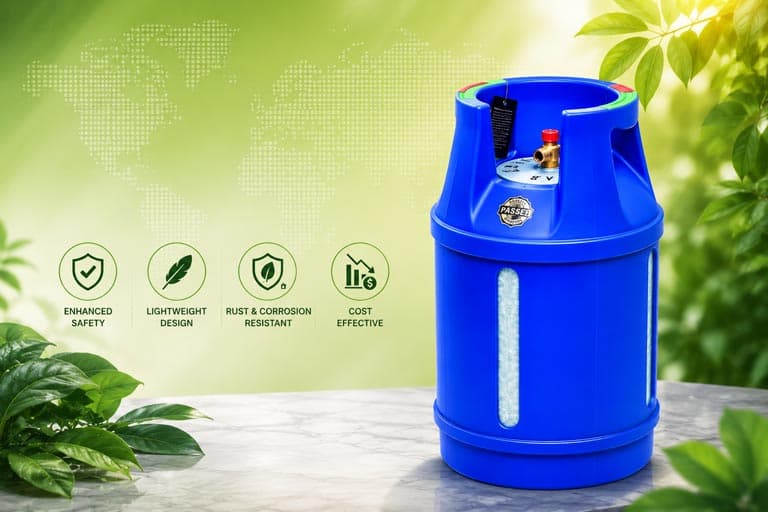
The most consequential safety characteristic of a WAATechnologies composite cylinder, specifically in the Ramadan kitchen context, is its non-blast design. WAA cylinders are manufactured using CNC filament winding — high-strength glass fibre is precisely wound under tension over an HDPE liner, creating a seamless composite pressure vessel with no welds, no seams, and no metal components in the cylinder body. This construction produces a cylinder that, under extreme conditions (fire exposure, severe over-pressure from overheating), will develop a controlled gas permeation through the composite shell rather than a catastrophic structural failure.
A conventional steel cylinder in the same extreme conditions behaves differently. Steel conducts heat rapidly into the cylinder contents. Internal pressure builds quickly as LPG inside heats and expands. When the structural limit of the steel is reached — which happens much faster than it does for composite construction — the cylinder ruptures. Steel cylinder rupture under pressure is not a slow failure. It is an explosion, projecting lethal shrapnel at high velocity in all directions. In a kitchen fire context, a steel cylinder explosion typically causes the kitchen to be destroyed and inflicts severe injuries or death on anyone in the vicinity.
During Ramadan, when kitchens are more intensively used and more people are present during cooking sessions, the non-blast guarantee of a WAA composite cylinder is the most important reason to make the switch. The scenario it protects against — a kitchen fire that escalates to cylinder involvement — is precisely the scenario where the maximum number of family members are most likely to be nearby. The composite cylinder's non-blast response converts what would be a catastrophic explosion into a serious but survivable gas fire incident.
Translucent Body: Never Run Out at Sehri
The HDPE outer shell of a WAA composite cylinder is translucent — you can see through it to observe the liquid LPG level inside, exactly as you can see the water level in a clear plastic water bottle. This visual level monitoring eliminates one of the most common and frustrating Ramadan gas incidents: discovering at 4 AM that the cylinder is empty, with Sehri preparation half-finished, no dealer open, and no backup available. A daily 5-second visual check of the cylinder level before beginning Sehri preparation tells you exactly whether you have sufficient gas for the session. When the level drops to approximately one-quarter of the cylinder height, it is time to contact your dealer for a refill — not when it drops to zero.
Half the Weight of Steel: Safer Pre-Dawn Handling
A fully filled steel 11.8 kg cylinder weighs 27–28 kg. At 4 AM, fasting, tired, in a potentially dark or dimly lit kitchen, handling this weight safely requires the full physical capacity of a reasonably strong adult. For many Pakistani households — where cylinder handling often falls to women, elderly family members, or anyone who happens to be awake — a 27 kg cylinder is a strain and a fall risk. A WAA composite cylinder weighs 17–20 kg fully filled. This is a weight that any adult household member can manage safely and comfortably without assistance, under any conditions, at any time of day or night. The weight reduction does not sound like a safety feature until you consider who is actually handling the cylinder, when, and under what conditions — and then it sounds like exactly that.
Corrosion-Free Storage Between Ramadans
Many Pakistani households store their LPG cylinder between uses — particularly households that use LPG primarily during Ramadan and winter shortage periods. Steel cylinders stored in typical Pakistani household storage conditions — utility rooms, outdoor areas, rooftop storage — corrode progressively between uses. The corrosion concentrates at the cylinder base (where moisture accumulates), at valve seat interfaces (where condensation from temperature cycling occurs), and at any scratches or chips in the paint coating. A steel cylinder stored for 10 months between Ramadans can develop significant corrosion that manifests as leaks when the cylinder is refilled and pressurised for the new Ramadan season.
WAA composite cylinders cannot corrode. HDPE and fiberglass are chemically inert and completely immune to moisture, salt air, UV radiation, and the temperature cycling of storage conditions. A WAA composite cylinder stored for 11 months between one Ramadan and the next will be in exactly the same condition as when it was put into storage. The valve is the only metal component and is protected by the HDPE valve boss. This storage durability means the composite cylinder pressed into service for the first Sehri of every Ramadan is a known-safe, known-reliable piece of equipment — not a question mark whose storage-period condition needs assessment.
The Complete Ramadan Gas Safety Checklist
- One week before Ramadan: Inspect regulator hose along full length — replace if over 2 years old, if any cracks visible, or if stiff
- One week before Ramadan: Soap-test all connections with cylinder valve open and stove knobs closed — repair any leaks before proceeding
- One week before Ramadan: Clean all stove burner jets and caps — confirm clean blue flames after reassembly
- One week before Ramadan: Install or test CO detector at floor level in kitchen
- Before first Sehri: Check composite cylinder gas level visually — ensure sufficient for the session
- Before every Sehri: Designate one adult as stove monitor — they do not leave the kitchen while any burner is alight
- After every Sehri: Close cylinder valve before sitting down to eat
- Before Iftar cooking: Open kitchen window; confirm dupatta and loose clothing secured for all cooks
- During Iftar: Never leave hot oil unattended on any burner for any duration
- After Iftar is served: Close cylinder valve before joining the family at the table
- Before Taraweeh: Confirm cylinder valve closed; confirm no burner is alight
- Before sleeping: Confirm cylinder valve closed
- Throughout Ramadan: Keep children away from active burners; brief older children on gas safety rules
- If gas smell detected: No electrical switches, no flames, open windows and doors, evacuate, call technician
Frequently Asked Questions
Is it safe to use an LPG cylinder for all of Sehri and Iftar cooking every day during Ramadan?
Yes, absolutely — with proper setup, maintained equipment, and the safety habits described in this guide. LPG is a safe, clean, and reliable cooking fuel when used correctly. The safety tips in this article are about managing the additional risks that Ramadan conditions create, not about restricting normal cooking activity. A household with a well-maintained WAA composite cylinder, clean stove burners, a sound regulator hose, and the cylinder valve shutdown habit can cook every Sehri and Iftar through the full 30 days of Ramadan with complete safety.
How long does a 10 kg composite cylinder last during Ramadan cooking?
A family of 5–6 cooking Sehri and Iftar daily during Ramadan, with LPG as the primary cooking fuel, will typically consume 0.5–0.8 kg of LPG per day — meaning a 10 kg cylinder lasts approximately 12–20 days during Ramadan. It is advisable to have a second cylinder as backup so that a cylinder change can happen mid-Ramadan without any interruption to cooking continuity. Arrange the refill of the first cylinder as soon as it is collected by the dealer so it is ready when needed.
My steel cylinder has been in storage since last Ramadan. Is it safe to use?
Have it inspected before use. A steel cylinder stored for 11 months should be checked for: body corrosion (particularly at the base and around the valve); valve condition and operation; and any physical damage from storage. If there is significant rust, especially around the valve, have it assessed by a technician or LPG dealer before refilling and using. This is one of the strongest arguments for switching to a composite cylinder — a WAA composite cylinder stored for 11 months is in exactly the same condition as when stored, with no corrosion, no rust, and no need for a storage-condition assessment before Ramadan use.
Conclusion: A Safe Ramadan Starts with Preparation, Not Caution
Gas safety during Ramadan is not about being fearful of your kitchen or your LPG cylinder. It is about understanding the specific conditions that Ramadan creates — the fatigue, the intensity, the crowding, the time pressure — and taking the concrete steps that ensure those conditions do not combine with equipment failure or safety lapses to cause an incident. The preparation steps in this guide take a total of approximately 2–3 hours before Ramadan begins. The cylinder valve shutdown protocol takes 3 seconds after every cooking session. The stove monitor rule requires attention, not effort. These are modest investments in safety that protect your family through 29 or 30 days of intensive kitchen use.
Ramadan Mubarak from all of us at WAATechnologies. Every Pakistani family deserves a safe, blessed, and worry-free holy month. For WAA composite LPG cylinders and the nearest authorised dealer, contact us at (+92) 4237815533 or visit 172-A First Floor, Adjacent Bahria Grand Masjid, Sector E Commercial Bahria Town Lahore. Visit our online shop to order your composite cylinder before Ramadan begins.