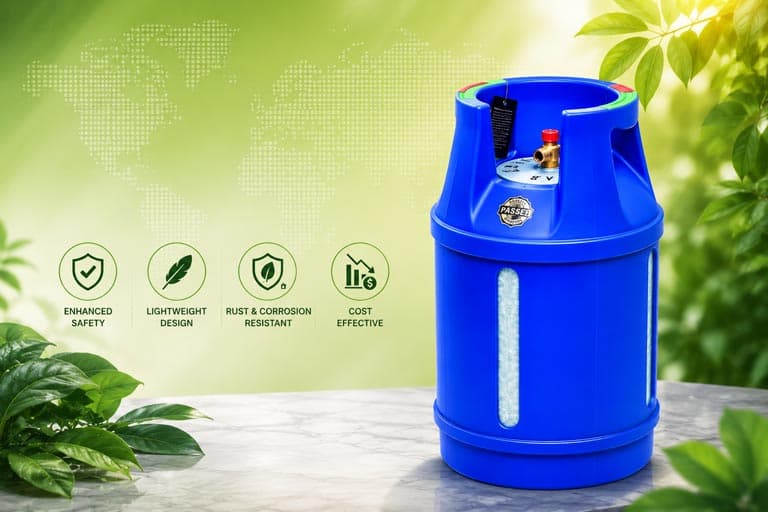
OGRA regulates every LPG cylinder sold and used in Pakistan. Most households and even many businesses are unaware of what is legal, what is not, and what an inspector will check. This guide covers the complete OGRA LPG cylinder rulebook in plain language.
Key Takeaways
- ✓OGRA is the sole federal regulator for all LPG activities in Pakistan — manufacturing, distribution, refilling, and retail sale
- ✓Every LPG cylinder legally sold in Pakistan must be manufactured by an OGRA-licensed manufacturer and meet Pakistan Standard PS 4922 or equivalent international standards
- ✓Steel cylinders must be hydrotested every 5 years — cylinders without a valid hydrotest date cannot legally be refilled
- ✓OGRA requires all LPG cylinders to display the manufacturer name, test date, tare weight, and capacity permanently on the cylinder body
- ✓Using uncertified or non-compliant LPG equipment in a commercial premises can result in immediate closure orders and criminal charges under the Petroleum Act
The Oil and Gas Regulatory Authority — OGRA — is Pakistan's federal regulator for the entire LPG value chain. Its mandate covers every step from LPG production and import, through storage and distribution, to the cylinder that sits in your kitchen. Despite this comprehensive mandate, a very large number of Pakistani households, and even many businesses, have almost no knowledge of what OGRA actually requires from an LPG cylinder, what the rules mean in practice, and how to verify whether a cylinder or equipment item is legally compliant. This matters: non-compliance is not just a legal risk. It is a direct safety risk, because OGRA's rules exist specifically to prevent the cylinder blasts and gas leaks that kill hundreds of Pakistanis every year.
This guide covers OGRA's complete LPG cylinder rulebook in plain language — what standards cylinders must meet, how to check compliance markings, the rules on refilling and hydrotesting, dealer licensing requirements, and the specific rules for commercial premises.
OGRA's Legal Authority Over LPG Cylinders
OGRA was established under the Oil and Gas Regulatory Authority Ordinance 2002 and operates under the Petroleum Act 1934 (as amended). Its jurisdiction over LPG activities is defined in the Liquefied Petroleum Gas (Production and Distribution) Rules 2001, as subsequently amended. These rules govern every licensed activity in the LPG chain and empower OGRA inspectors to inspect any premises where LPG is stored, sold, or used commercially, to examine cylinders and equipment for compliance, and to issue immediate stop-use orders or prosecution notices for non-compliant equipment.
OGRA's enforcement arm works in coordination with provincial civil administrations, the Pakistan Standards and Quality Control Authority (PSQCA), and, for commercial premises, municipal safety departments. During routine market inspections and post-incident investigations, OGRA inspectors check cylinders against the compliance criteria described below.
The Pakistan Standard for LPG Cylinders: PS 4922
The primary Pakistani standard for LPG cylinders is PS 4922, administered by PSQCA under OGRA's oversight. PS 4922 sets minimum requirements for cylinder construction, material specification, pressure testing, valve requirements, marking, and service life for conventional steel LPG cylinders. Compliance with PS 4922 is mandatory for all steel cylinders manufactured for or imported into Pakistan.
For composite (fibre) cylinders — a newer category that PS 4922 does not fully cover — OGRA currently accepts international equivalents: primarily ISO 11119-3 (which governs composite cylinders with load-bearing fibre-reinforced plastic with non-load-bearing metallic liners) and EN 14427:2022 (the European standard for transportable refillable composite cylinders). Composite cylinders must carry certification markings from an accredited testing laboratory demonstrating compliance with one of these international standards to be legally marketed and sold in Pakistan.
Mandatory Markings: What Every Legal Cylinder Must Show
OGRA requires that every LPG cylinder legally placed on the Pakistani market display the following information permanently on the cylinder body. These markings allow you to verify a cylinder's identity, age, and compliance status at a glance:
- Manufacturer name and country of manufacture
- Date of manufacture (month and year)
- Cylinder serial number — unique to each unit
- Tare weight (empty cylinder weight in kg)
- Water capacity (litres)
- Working pressure and test pressure (bar)
- Standard to which manufactured (PS 4922, ISO 11119-3, EN 14427, etc.)
- Date of last periodic test (hydrotest for steel; cycle test record for composite)
- Service life expiry date
If any of these markings are absent, illegible, or appear to have been tampered with, the cylinder is non-compliant and should not be used. Report non-compliant cylinders to your LPG dealer and, for commercial premises, to OGRA directly.
The Hydrotest Rule for Steel Cylinders
OGRA requires all steel LPG cylinders to be subjected to a hydrostatic pressure test every 5 years. The hydrotest fills the cylinder with water and pressurises it to 1.5 times its working pressure to check for leaks, deformation, and structural weakness. Cylinders that fail the hydrotest must be decommissioned. Cylinders that pass receive a new test date stamp.
A steel cylinder whose most recent hydrotest date is more than 5 years ago cannot legally be refilled at any OGRA-licensed filling station. In practice, enforcement of this rule at the retail refilling level in Pakistan is inconsistent — many informal dealers refill cylinders regardless of test date. However, using a cylinder that is overdue for hydrotesting is both illegal and genuinely dangerous: it is the primary reason why structurally compromised old cylinders continue to circulate in Pakistani households.
Composite cylinders like WAA Technologies models do not require periodic hydrotesting in the same way as steel. Their construction does not degrade in the corrosion-driven way that makes periodic hydraulic testing necessary for steel. WAA composite cylinders carry a 20+ year rated service life validated through ISO 11119-3 testing protocols that include accelerated aging and fatigue cycle testing.
Rules for LPG Dealers and Refilling Stations
Every LPG dealer who sells, stores, or refills cylinders must hold a current OGRA licence for their specific activity class. OGRA licences for LPG distributors and dealers are renewed annually and require: proof of safe storage facilities, calibrated weighing equipment for filling, trained staff with valid safety certificates, and a cylinder record-keeping system that tracks cylinder serial numbers and test dates.
Dealers are prohibited under OGRA rules from: refilling cylinders that are overdue for hydrotesting; filling cylinders to more than 80% of their rated capacity; selling cylinders without the mandatory markings described above; and supplying cylinders to customers without a compliant regulator and hose.
OGRA Rules for Commercial Premises
Businesses that use LPG — restaurants, hotels, bakeries, factories, event caterers — are subject to more rigorous OGRA compliance requirements than domestic households. Commercial premises must: maintain a cylinder inventory register; ensure all cylinders in use are within their test date validity; store cylinders in ventilated, fire-separated spaces away from cooking equipment; install compliant gas leak detectors; and provide documented staff safety training records.
OGRA inspections of commercial premises are more frequent and more consequential than household spot checks. An inspector finding non-compliant cylinders in a commercial kitchen can issue an immediate stop-use notice, require replacement of all non-compliant equipment within 48 hours, and, in cases of repeated or serious non-compliance, refer the matter for prosecution under the Petroleum Act. The maximum penalty for serious non-compliance includes imprisonment and substantial fines.
How WAA Technologies Composite Cylinders Satisfy OGRA Requirements
WAA Technologies Pvt Ltd manufactures composite LPG cylinders at its Gujranwala facility to ISO 11119-3 and EN 14427-2022 international standards — both of which are accepted by OGRA as equivalent to or exceeding the PS 4922 requirements for composite cylinder construction. Each WAA cylinder carries: individual serial number, manufacture date, tare weight, test pressure, standard certification reference, and service life date — all permanently marked on the cylinder body in compliance with OGRA marking requirements.
WAA cylinders are distributed exclusively through OGRA-licensed dealers across Punjab, Sindh, and KPK. Purchasing through an authorised WAA dealer guarantees that the cylinder, the refilling station, and the dealer are all operating within OGRA's licensing framework — giving you both legal compliance and the highest available safety standard in a single purchase decision.
Frequently Asked Questions About OGRA LPG Cylinder Rules
How do I check if my LPG cylinder is OGRA compliant?
Check the cylinder body for all mandatory markings: manufacturer name, manufacture date, serial number, tare weight, water capacity, test pressure, applicable standard (PS 4922, ISO 11119-3, or EN 14427), last hydrotest date, and service life expiry. If any marking is absent or the last hydrotest date is more than 5 years ago on a steel cylinder, the cylinder is non-compliant. For composite cylinders, verify that an ISO 11119-3 or EN 14427 certification reference is present.
What is the penalty for using an uncertified LPG cylinder in Pakistan?
For household use, OGRA's enforcement primarily targets the dealer level rather than individual consumers. However, for commercial premises, using uncertified LPG equipment can result in immediate closure orders, equipment confiscation, and prosecution under the Petroleum Act 1934. Commercial operators have been fined and in serious cases faced criminal charges following cylinder blast incidents where equipment was found to be non-compliant.
Does OGRA require a specific regulator type for LPG cylinders?
OGRA requires that LPG regulators used with domestic cylinders be certified to PS 578 (the Pakistani standard for LPG pressure regulators) or equivalent. The regulator must be compatible with the cylinder valve type and set to the correct output pressure for the appliances in use. OGRA does not prescribe a single regulator brand but requires that any regulator used is certified to the applicable standard and in serviceable condition.
How often does OGRA inspect residential LPG users?
OGRA does not routinely inspect individual residential LPG users. Enforcement at the household level occurs primarily following incident investigations — after a blast or fire has been reported. OGRA's routine inspection focus is on licensed dealers, filling stations, storage facilities, and commercial premises. This is why household awareness of the rules matters: residential compliance is largely self-enforced.