With electricity load shedding stretching 10–14 hours in parts of Pakistan, LPG-powered cooking has become the practical choice for millions of households. Here is why composite cylinders are the smartest way to make the switch.
Key Takeaways
- ✓LPG cooking costs 3–5x less than electric cooking at current Pakistan electricity tariff rates
- ✓Electric cooktops fail precisely during Sehri and Iftar — the moments when cooking cannot wait
- ✓Pakistan's load shedding is structural and projected to continue for at least 5–7 more years
- ✓Composite cylinders are the safest LPG option for households using gas as primary cooking fuel daily
- ✓Pakistan's restaurant industry switched from electric to gas years ago — households are catching up
At 7 PM in the evening during a Lahore summer, a working mother arrives home to prepare dinner. She turns on the induction cooktop. Nothing happens. The load shedding that started at 6 PM will not end until 10 PM. The rice will not cook. The curry will not simmer. The family will eat biscuits, or leftover roti from the morning, or nothing — because the cooking fuel of choice, electricity, is unavailable precisely when it is needed most. This scene, repeated in millions of Pakistani households daily, is driving one of the most significant household energy shifts Pakistan has seen in a generation: the mass switch from electric to LPG gas cooking.
Pakistan's electricity load shedding crisis is not a temporary disruption. It is a structural consequence of a power sector circular debt that has grown beyond Rs 2.7 trillion, a generation fleet that cannot be adequately fuelled because the fuel cannot be paid for, a distribution infrastructure that loses 20–25% of power as technical and commercial losses, and a tariff structure that prices electricity beyond the reach of millions of households while simultaneously failing to generate enough revenue to cover generation costs. None of these problems will be resolved quickly. The International Monetary Fund's structural reform programme addresses them over a 3–5 year horizon at best. Pakistan's households need cooking fuel today, this evening, when the power goes out — not in 2028 when the circular debt may or may not have been meaningfully reduced.
The answer that millions of Pakistani households have arrived at independently, through practical necessity, is LPG. Stored in a pressurised cylinder in the kitchen, LPG is independent of the grid, available on demand, cost-effective, and — when stored in a WAATechnologies composite cylinder — safe in ways that conventional steel cylinders are not. This article makes the complete case for LPG cooking as Pakistan's rational response to load shedding, and explains specifically why composite cylinders are the right choice for making this switch.
The True Scale of Pakistan's Load Shedding Problem
What the Official Schedules Say and What Households Actually Experience
Pakistan's power distribution companies (DISCOs) publish load shedding schedules that specify planned outage hours by feeder and area. These schedules are the official record of how much load shedding consumers are supposed to receive. The gap between these official figures and what households actually experience is significant. DISCO schedules typically cover planned, scheduled outages. They do not capture: unscheduled outages caused by transformer overloading and failure during peak summer demand; feeder-tripping events caused by conductor faults and overloads; voltage reduction events where power is technically available but at insufficient voltage to run appliances; and the cumulative effect of multiple short outages in a day that the schedule shows as a single longer outage.
In practice, households in Lahore's residential areas that official schedules show receiving 6–8 hours of load shedding frequently experience 10–14 hours of total effective outage. In Faisalabad and Gujranwala, where industrial load is highest and transformer stress peaks during summer, residential outages routinely exceed 12 hours. In smaller cities and peri-urban areas of Punjab, and across most of KPK and interior Sindh, 14–18 effective outage hours per day are not uncommon during the summer peak demand period of May through August — which in recent years has aligned with Ramadan, compounding the hardship of both simultaneously.
The Circular Debt: Why This Is Not Going Away
Pakistan's power sector circular debt is the financial mechanism through which load shedding is perpetuated. The chain works as follows: electricity consumers receive subsidised or under-cost electricity from DISCOs. DISCOs collect less revenue than the cost of electricity they distribute. DISCOs therefore cannot pay the National Power Purchase Agreement (NTDC/CPPA-G) in full for the power they procure. CPPA-G cannot fully pay Independent Power Producers (IPPs) for their capacity and energy charges. IPPs cannot fully pay their fuel suppliers — PSO for oil and gas, RLNG importers for LNG. Fuel suppliers restrict supply. IPPs reduce generation for lack of fuel. The grid faces a generation shortfall. Load shedding results.
This cycle has been growing for over a decade. IMF programmes since 2019 have required Pakistan to progressively reduce power sector subsidies through tariff increases — the residential electricity tariff has increased from approximately Rs 12–16 per unit in 2019–2021 to over Rs 50 per unit in 2025. Despite these increases, the circular debt has continued growing because the structural inefficiencies of the system (high transmission losses, non-payment by government consumers, over-contracted IPP capacity) absorb the additional revenue without resolving the fundamental imbalance. Solving the circular debt requires structural reforms that take years to implement and deliver results. Pakistan's households cannot wait for structural reform before they need to cook dinner.
Geographic Variation: Where Load Shedding Hits Hardest
Load shedding severity in Pakistan follows a clear geographic pattern that mirrors the financial stress of each DISCO. LESCO (Lahore Electric Supply Company) and FESCO (Faisalabad Electric Supply Company) serve the most industrial and commercial load in Pakistan, with complex feeder networks that are chronically over-stressed. These are among the highest-load-shedding areas for residential consumers, paradoxically, because the industrial and commercial consumers these DISCOs serve are most critical to protect. PESCO (Peshawar Electric Supply Company) serves KPK, where transmission infrastructure is older and less developed, recovery rates from consumers are lower, and load shedding can exceed 18 hours in remote areas. HESCO and SEPCO (Hyderabad and Sukkur in Sindh) serve interior Sindh, where agricultural feeders receive the highest outage hours and household consumers in small towns can face near-complete daily outages.
The households with the strongest incentive to switch to LPG cooking are, not coincidentally, in precisely these high-load-shedding areas. A family in suburban Lahore experiencing 12 hours of outage per day has an overwhelming economic and practical incentive to ensure their cooking does not depend on the grid. A household in a KPK district town experiencing 16-hour outages is making an LPG cylinder a domestic necessity, not a lifestyle choice. The switch to LPG cooking in Pakistan is being driven from the bottom up — by households whose lived experience with load shedding has made the economic case for the switch more compelling than any government advisory or marketing campaign could.
The Economics of LPG vs. Electric Cooking in Pakistan Today
What Electricity Actually Costs Pakistani Households
Pakistan's residential electricity tariff structure has become extraordinarily punishing for households that use significant electricity for cooking. The tariff is structured in slabs: lower consumption gets a lower per-unit rate, but once a household exceeds certain monthly consumption thresholds, all units consumed shift to a higher slab rate. A household using an induction cooktop for daily Pakistani cooking — which involves extended simmering, high-heat frying, pressure cooking, tawa bread preparation, and multiple daily cooking sessions — easily consumes 5–8 units of electricity per day in cooking alone. This cooking load, added to lighting, fans, refrigeration, and other household consumption, pushes many Pakistani households into higher tariff slabs.
At the blended effective rate that a typical Pakistani middle-income household pays — accounting for slab rates, fuel adjustment charges (which can add Rs 5–15 per unit on top of the base tariff), fixed charges, and taxes — cooking-related electricity consumption can cost Rs 300–500 per day for a family that cooks three meals. Over a 30-day month, this is Rs 9,000–15,000 in cooking-related electricity costs alone. These are not imaginary figures — they reflect the actual electricity bills that Pakistani households with electric cooking setups have been receiving since the tariff increases of 2023–2025.
What LPG Cooking Actually Costs
A 10 kg LPG cylinder refill costs approximately Rs 2,500–3,200 at current market rates (the range reflects geographic variation between urban and rural dealer pricing). A family of 5–6 cooking all meals on LPG will typically consume this cylinder over 5–7 weeks of regular cooking use — approximately 0.3–0.4 kg per day for cooking-only usage. At this consumption rate, the monthly LPG cooking cost is Rs 1,600–2,500 — depending on cylinder size, consumption pattern, and local dealer pricing. This is 20–40% of what the equivalent cooking load costs on electricity at current tariff rates.
The savings are largest for households that were previously cooking entirely on electricity (induction cooktop or electric stove) and switch to LPG as their primary cooking fuel. For these households, the monthly savings from the switch can be Rs 7,000–12,000 per month — enough to recover the cost of a composite cylinder and stove purchase within 1–3 months. The LPG cylinder and stove are not a cost; they are an investment with a payback period measured in weeks.
The Reliability Premium: Why Continuity Has Financial Value
Beyond the direct unit cost comparison, LPG cooking has a reliability value that electricity simply cannot provide in Pakistan's current energy environment. A household that can reliably cook every meal on schedule — regardless of load shedding — experiences no food wastage from uncooked perishables, no expenditure on take-out food during outages, no productivity loss from meal preparation delays that ripple into school and work schedules, and no stress cost from the daily uncertainty of whether power will be available when cooking needs to happen. These reliability benefits have real economic value that does not appear in a simple unit cost comparison but that Pakistani households intuitively understand and experience as a meaningful quality-of-life improvement from the day they make the switch.
Why LPG Outperforms Electricity for Pakistani Cooking Specifically
The Physics of Gas Cooking for Pakistani Cuisine
Pakistani cuisine is, in its dominant forms, high-heat cooking. The karahi — arguably Pakistan's most iconic cooking format — requires sustained intense heat to achieve the oil separation, caramelisation, and charring that define the dish. A good karahi cannot be made on low heat with extended cooking time; it is an inherently high-heat, short-time preparation. Similarly, the layering and dum stage of biryani requires precise heat management that shifts rapidly between high heat and very low simmer — a sequence that gas stoves handle with immediate, precise response that induction surfaces approximate but do not replicate.
Roti and paratha on a tawa requires a hot, evenly heated surface that responds immediately to the cook's adjustments. The tawa must heat quickly, maintain high even temperature, and cool rapidly when adjusted — all characteristics that suit the gas flame's direct, responsive heating. Induction tawa surfaces heat the tawa through electromagnetic induction rather than direct flame, producing slightly different heat distribution that experienced Pakistani roti-makers consistently report produces inferior results. Pressure cooker cooking for daal and legumes — the basis of Pakistani everyday cooking — requires the sustained high boil that gas provides efficiently and electricity provides expensively.
These are not marginal differences. They reflect the fundamental compatibility between gas cooking technology and Pakistani cooking techniques that was established over generations of household practice. Pakistani cooking evolved with gas flames. Adapting it to electric cooking requires compromises that reduce the quality of results — and that Pakistani cooks who have tried the adaptation and returned to gas will readily describe.
Instant Heat, Instant Control
A gas burner goes from off to maximum heat in one second. It goes from maximum heat to minimum simmer in one second. This instant responsiveness is the defining practical advantage of gas cooking for Pakistani meal preparation, which involves rapid transitions between high heat (frying, searing) and low heat (simmering, keeping warm). Electric cooking surfaces — whether resistance coil, ceramic glass, or induction — have thermal lag: they heat slowly relative to gas and cool slowly relative to gas. A cook managing four simultaneous preparations on a gas stove has immediate, precise control over each. On an electric stove, every adjustment involves a delay while the element heats up or cools down.
In the context of load shedding, this instant availability is doubly valuable. When load shedding ends and power is restored for a 4-hour window, the pressure to complete all cooking tasks in that window creates exactly the kind of time pressure that gas cooking handles best. The gas burner that lights in a second and reaches full heat in a second is the right tool for cooking under time pressure — not the electric element that takes 3–5 minutes to reach cooking temperature.
What Pakistan's Restaurant Sector Already Knows
Pakistan's commercial food sector arrived at the conclusion that gas cooking is the only viable option for Pakistani cuisine years before most households. No successful restaurant in Lahore, Karachi, or Islamabad cooks primary dishes on electricity. The reason is not just culinary preference — it is operational reality: a restaurant that cannot cook during a 4-hour load shedding window during the dinner rush loses revenue, loses customers, and loses reputation. The restaurant sector made the capital investment in gas cooking infrastructure because the alternative — electricity dependency — was functionally incompatible with running a food business in Pakistan.
The same logic applies to households, with the same urgency. A family that cannot cook dinner during a 6-hour load shedding window is not running a profitable restaurant — it is a family that goes without a hot meal. The household equivalent of the restaurant's gas cooking investment is an LPG cylinder setup: cylinder, regulator, hose, and stove. The investment is far more modest than commercial kitchen infrastructure. The operational benefit is identical: the ability to cook regardless of whether the power is on.
Why Composite LPG Cylinders Are the Right Choice for Pakistan's Load-Shedding Households
Safety: The Foundation of Every Other Benefit
A household that has decided to switch to LPG cooking as its primary cooking fuel — not just occasional backup — is making a decision to have an LPG cylinder as a permanent fixture in its kitchen. This cylinder will be in use daily, connected to a stove, in a room where family members including children spend significant time. The safety properties of that cylinder are therefore not a secondary consideration — they are the foundation on which every other benefit of the switch rests. If the cylinder is not safe, nothing else about the switch matters.
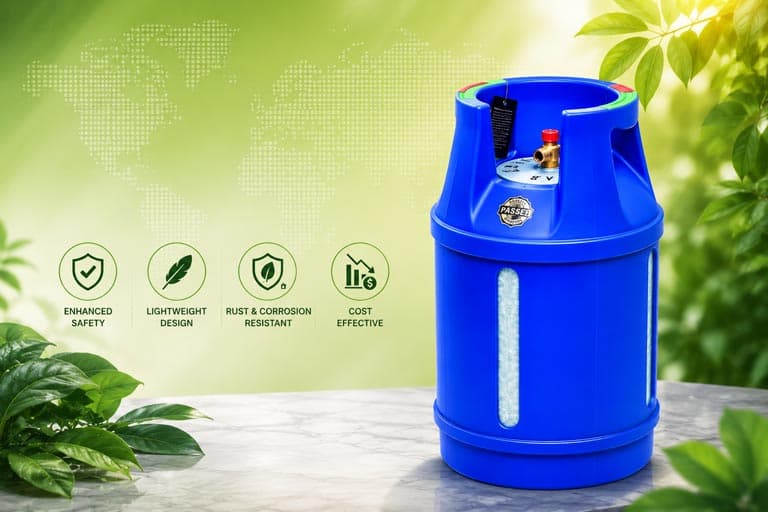
WAATechnologies composite LPG cylinders are manufactured to be non-blast. The glass fibre composite shell wound over an HDPE liner creates a pressure vessel that responds to extreme over-pressure or heat exposure by developing a controlled gas permeation through the composite material — venting gas gradually rather than rupturing catastrophically. Steel cylinders respond to the same conditions with sudden, complete structural failure — an explosion that projects lethal metal fragments at high velocity in all directions. In the context of a cylinder that will be in daily use in a Pakistani family kitchen for the next 20 years, the non-blast guarantee of a composite cylinder is not an abstract safety certification. It is a concrete commitment that, in the event of a kitchen fire or severe accident involving the cylinder, the outcome will be a gas fire rather than an explosion — a serious incident versus a potentially fatal one.
See-Through Level Visibility: End the Empty Cylinder Surprise
The second most important practical advantage of a WAA composite cylinder for a load-shedding household is one that sounds simple but has significant daily value: you can see how much gas is in it. The translucent HDPE outer shell of a WAA composite cylinder lets you observe the liquid LPG level inside at a glance, exactly as you see the water level in a plastic bottle. You can check the level before starting any cooking session, monitor it declining over days and weeks, and plan your dealer refill well in advance of running empty.
For a household that relies on LPG as its primary cooking fuel during load shedding, running the cylinder empty mid-cooking is not a minor inconvenience — it is a cooking failure at exactly the moment when cooking on electricity is also impossible. The visible level monitoring that WAA composite cylinders provide eliminates this failure mode entirely. A daily 5-second visual check is all that is required. When the level reaches one-quarter of the cylinder height, you call the dealer — not when it reaches zero.
Half the Weight: Daily Use at Human Scale
A household using LPG as its primary cooking fuel will move, connect, and swap cylinders regularly throughout the year — not just during occasional shortage periods. A standard steel 11.8 kg cylinder weighs 27–28 kg fully filled. Moving this cylinder from a storage position to the kitchen connection point, connecting the regulator, and managing the swap when it empties requires the physical capacity of a reasonably strong adult. For the majority of Pakistani households where daily kitchen management falls primarily to women — and where the person most likely to need to manage a cylinder swap may be a woman alone, an elderly person, or a teenager — 27 kg is a real physical barrier.
A WAA composite cylinder fully filled weighs 17–20 kg, depending on size. This is a weight that is genuinely manageable for any adult household member without assistance or physical strain. Over a year of daily LPG cooking use, the difference between managing a 27 kg cylinder and a 20 kg cylinder is not trivial — it is the difference between a task that requires planning and assistance and one that any household member can handle independently and safely.
Corrosion-Free for Daily Kitchen Environments
A cylinder in daily use in a kitchen is exposed to conditions that accelerate steel corrosion: cooking steam, water splash from washing up, the humidity of an active kitchen, and the temperature cycling between cooking heat and ambient temperature. A steel cylinder used daily in a Pakistani kitchen will show significant corrosion at the base and around the valve within 3–5 years. This corrosion concentrates at the points of greatest structural importance — the valve seal area and the cylinder base. The result is a cylinder that, years before its formal retirement date, is showing the early warning signs of the corrosion that will eventually force its replacement.
WAA composite cylinders cannot corrode. The HDPE outer shell and fiberglass composite body are chemically inert — immune to moisture, cooking steam, cleaning water, ambient humidity, and temperature cycling. A WAA composite cylinder used daily in a Pakistani kitchen for 20 years will have the same structural integrity at year 20 as it did at year 1. There is no corrosion to develop, no rust to inspect for, no premature retirement from kitchen environment degradation. The cylinder is a 20-year asset that performs consistently and safely throughout its rated service life.
20-Year Service Life: Investment, Not Expense
The switch to LPG cooking for a household involves an upfront capital cost: composite cylinder purchase, regulator, hose, and potentially a gas stove or additional burner. This cost should be evaluated as an investment with a defined service life and a calculated return — not as a one-time expense. The WAA composite cylinder purchased today will be in service for 20+ years. Over those 20 years, it will provide daily cooking reliability during load shedding and other supply disruptions. It will save the household thousands of rupees per month in avoided electricity costs. And it will do so with a non-blast safety guarantee that steel cylinders cannot match.
The steel cylinder alternative, at a lower initial purchase price, will last 8–12 years before corrosion forces replacement. Over the same 20-year period, the steel cylinder household makes 1.5–2 cylinder purchases versus the composite household's one. The total capital cost over 20 years is comparable or, when maintenance and corrosion-related early replacement are factored in, favours the composite option. The safety differential over those 20 years is not comparable — it is categorically better with composite.
A Step-by-Step Guide to Making the Switch to LPG Cooking
Step 1: Assess Your Household's Cooking Needs
Before purchasing, assess: How many people are you cooking for? How many meals per day are prepared at home? Will this be your primary cooking fuel (all cooking on LPG) or a backup (LPG only during load shedding)? For a family of 4–6 using LPG as the primary cooking fuel, two 10 kg cylinders — one in active use, one as backup — is the optimal starting configuration. For a household using LPG only as a load shedding backup for a stove that also has a pipeline gas connection, one 10 kg cylinder is adequate as a starting point, with a second purchased after assessing actual consumption.
Step 2: Choose the Right WAA Composite Cylinder Size
WAATechnologies manufactures composite cylinders in three sizes: 5 kg, 10 kg, and 12 kg. The 5 kg cylinder is ideal for supplementary use, single-person households, or as an emergency backup at a weekend home or vacation property. The 10 kg cylinder is the optimal size for most Pakistani families of 3–6 people using LPG for cooking — it provides 4–7 weeks of supply at typical household cooking consumption rates and is light enough when empty (approximately 6–7 kg) for any household member to handle. The 12 kg cylinder is appropriate for larger families, households that cook for extended family regularly, or households that plan to use LPG for both cooking and heating.
Step 3: Purchase Through an Authorised Dealer
WAATechnologies composite cylinders are available exclusively through an authorised dealer network across Punjab, Sindh, and KPK. Authorised dealers supply genuine, individually serialised and certified cylinders with full manufacturer warranties. They also supply matched high-quality regulators and can provide guidance on compatible hose and connection fittings for your stove. Purchasing through authorised channels is the only way to ensure you receive a cylinder that has been individually hydro-tested and certified at the WAA Gujranwala manufacturing facility — not a counterfeit, a rebranded import, or an uncertified product from the unregulated secondary market.
Step 4: Professional Installation
Have a qualified gas technician install your LPG connection. The technician will correctly fit the regulator to the cylinder valve (ensuring the correct pressure setting for your stove type), connect the hose with appropriate fittings at both ends, verify that the hose is of the correct length and not kinked or routed near heat sources, and leak-test the complete installation with a soap solution before commissioning. This professional installation step typically takes 20–30 minutes and costs a modest fee. It is not optional — an improperly installed LPG connection is a gas leak risk, and a gas leak in a household already dealing with load shedding stress and the pressures of daily life is a scenario that professional installation eliminates at minimal cost.
Step 5: Install a Gas Leak Detector
Install a gas leak detector at floor level within 1–2 metres of your LPG cylinder. LPG is heavier than air — it sinks when it escapes from any leak, accumulating at floor level before it rises to higher areas of the room. A detector mounted at floor level will detect LPG accumulation at concentrations that are uncomfortable but not immediately dangerous, providing an alarm and time to ventilate the kitchen and address the leak before the concentration reaches explosive levels. Gas leak detectors are available from hardware stores, electrical shops, and LPG equipment dealers across Pakistan for modest cost. This single safety device provides continuous peace of mind for the daily-use LPG household.
Step 6: Establish the Three Core Safety Habits
From day one of using LPG as your primary cooking fuel, establish these three habits as non-negotiable household rules:
- Close the cylinder valve after every cooking session. Not just the stove knobs — the cylinder valve itself, at the source. With the valve closed, any leak that develops in the regulator or hose cannot deliver gas. This takes three seconds and eliminates the risk of overnight or absence-period gas accumulation from minor hose or regulator deterioration
- Check the cylinder level before every major cooking session. The translucent composite body makes this a 5-second visual check. Know how much gas you have before you begin. If you are below one-quarter level, arrange a refill before the cylinder runs out during a cooking session
- Replace the regulator hose every two years. Set a reminder. The hose is the most failure-prone component in any LPG setup. Rubber degrades internally before it shows external damage. Two-year replacement is inexpensive insurance against the most common cause of domestic LPG leaks
The Households That Will Regret Not Switching — and the Ones That Won't
Pakistan's load shedding trajectory over the next 3–5 years, under the most optimistic reform scenario, involves gradual improvement with continued significant outages during the transition period. During this period, households that have made the switch to LPG cooking will cook reliably, affordably, and safely regardless of the grid's behaviour. Households that defer the switch — telling themselves that load shedding will improve soon, that the investment is not worth it yet, that they will see how things go — will continue experiencing what they are experiencing now: missed meals, frustrated families, food wasted because cooking cannot happen on schedule, and the ongoing financial drain of expensive, unreliable electricity as a primary cooking fuel.
The load shedding crisis is not going away on a timeline that makes deferral a rational choice. The households that made the switch to LPG cooking in 2022, when load shedding first became severe, recovered their investment costs in months. The households that make the switch in 2025 will recover their investment costs in months. The households that defer to 2026 or 2027 will pay the cost of load shedding in missed meals and electricity bills for every month of deferral, in addition to recovering their investment cost once they finally switch. The optimal time to switch was when the crisis began. The second optimal time is now.
Frequently Asked Questions
Can I switch my existing gas stove from SNGPL pipeline gas to LPG?
Most domestic gas stoves can be converted from natural gas to LPG use by changing the burner jet orifice to a smaller LPG-specification size — LPG burns at higher pressure and calorific value than natural gas and requires a smaller orifice. A qualified gas technician performs this conversion in 30–60 minutes. Alternatively, LPG-specific stoves (single-burner, double-burner, and full four-burner models) are widely available at hardware shops and kitchen equipment stores throughout Pakistan and do not require any conversion — they are ready to use with your LPG cylinder and regulator directly.
How do I know which WAA composite cylinder size to choose?
For a family of 4–6 using LPG as the primary cooking fuel: two 10 kg cylinders is the recommended configuration. For a family using LPG only as a backup during load shedding and having a pipeline gas stove as primary: one 10 kg cylinder is adequate as a starting point. For a family of 6+ with heavy cooking requirements or plans to use LPG for heating in addition to cooking: two 12 kg cylinders. Contact your WAA authorised dealer to discuss your specific situation — they can advise on the right size and configuration for your household.
Is it safe to use an LPG cylinder in a small kitchen or apartment?
Yes, with appropriate ventilation and the safety habits described in this article. Apartments and small kitchens should ensure the cooking area has ventilation — a window that opens, a kitchen exhaust fan, or the ability to leave the kitchen door open during cooking. Install a gas leak detector at floor level. Always close the cylinder valve after cooking. With a WAA composite cylinder's non-blast design, the risk profile in a small kitchen is substantially better than with a conventional steel cylinder — there is no explosion risk if a fire occurs near the cylinder.
What happens to my LPG cylinder if load shedding ends and I go back to electricity?
A WAA composite cylinder has a 20+ year service life. If you switch back to electricity as your primary cooking fuel when and if load shedding improves, the cylinder retains its full value as a backup and emergency cooking resource. LPG does not expire in the cylinder — it can be stored for months or years without quality degradation. The cylinder remains available for the next shortage period, the next load shedding spike, or the next winter gas shortage. A composite cylinder purchased today is a 20-year household asset, not a short-term crisis purchase.
Conclusion: LPG Is Pakistan's Load-Shedding Cooking Solution — and Composite Is the Right Way to Do It
Pakistan's electricity load shedding has made electricity an unreliable cooking fuel for tens of millions of households. The response — switching to LPG cooking — is practical, economical, safe, and aligned with the cooking techniques that Pakistani cuisine demands. The choice of cylinder technology within that switch matters enormously: WAATechnologies composite cylinders provide non-blast safety, visible level monitoring, lightweight daily handling, and a 20-year service life that steel cylinders cannot match. Millions of Pakistani households have already made the switch. The data on electricity costs, reliability, and load shedding trajectories suggests that millions more should. The only question remaining is whether your household will be among those that prepare ahead of the next outage, or among those that discover the need for LPG while waiting in a dark kitchen for the power to come back.
WAATechnologies Pvt Ltd manufactures composite LPG cylinders to ISO 11119-3 and EN 14427-2022 international standards at their Gujranwala facility. Authorised dealers are available across Punjab, Sindh, and KPK. Contact us at (+92) 4237815533 or visit 172-A First Floor, Adjacent Bahria Grand Masjid, Sector E Commercial Bahria Town Lahore. Visit our shop to find the right composite cylinder for your household and make your home cooking load-shedding proof — starting today.